No matter how much money the IRS will lose, the IRS, Washington, and mainstream media want to tax US expats. The IRS and Washington want a government jobs program for accountants in the public and private sectors. And FATCA is the enforcement tool of USA’s stupid extra-territorial personal income tax system of Citizenship-Based-Taxation (CBT) (or US-person Based Taxation).
Note that USA and Eritrea are the only governments of the world that tax their expatriates and emigrants. But is USA making any money (tax revenue) out of the effort?
America’s first goal is to use U.S. expat citizens to fund the U.S. tax-preparer industry. A typical taxpayer is required to pay about $500 a year to hire a U.S. tax professional to fill out expat tax forms that are exponentially more complicated than tax forms for Homelanders. USA wants for the entire adult (over 25 yrs) U.S. expat population to pay for this. So, the compliance industry is fleecing the citizenry right good–a wealth transfer from those of modest means to tax preparation corporations (so what else is new?). But is the IRS gaining revenue?
We can look at what IRS costs are incurred, assuming that the IRS is successful in forcing every tax-eligible expat to file. The IRS is able to estimate the cost of each filer–unfortunately the IRS does not share those numbers with the public (it would defeat its self-serving job-security interest). Note that expat returns are at least doubly complicated than those of homelanders. Normally, the poor would be relieved of their need to file–-but with Obamacare, even the poor are required to file expat exemption papers. For example, expats can never be eligible for Obamacare, yet expats who file must file a form to exempt themselves from Obamacare penalties. Hence, it is likely that the entire adult expat population will file forms which can give IRS job security. 56% of the world are adults above 24 yrs, and there are 8.7 million U.S. expats. One could expand the analysis to try to determine the number of “US persons”, but this article will limit the scope to US citizen expats. (8.7 million)(0.56)* (processing cost of one filer)(doubled)(% above filing threshold).
In addition, there is a similar-but-different population of FBAR filers to consider. Each FBAR of every account of every expat who possesses more than $10,000 of financial wealth must also be processed. These FBARs must be filed and compared to the data which is obtained through the FATCA ethnic-identification system. FATCA’s public costs could also be considered in the calculation–FATCA is a big loser to the world’s economies. FATCA’s costs to the IRS government system are partly addressed in Wikipedia. However, “The I.R.S. “has been unable to ascertain all potential costs beyond those for IT resources”.
It’s important to remember that, despite media propoganda, FATCA and FBAR are not taxes and do not create tax revenue. They are expensive unconstitutional enforcement means of the money-losing extra-territorial tax regime system. Although sold to the public as revenue-enhancers by “increasing tax revenues”, enforcement methods and control systems always only add costs. This government doublespeak shows up in every Congressional spending bill (correctly stated as not a tax) but as “revenue enhancement”.
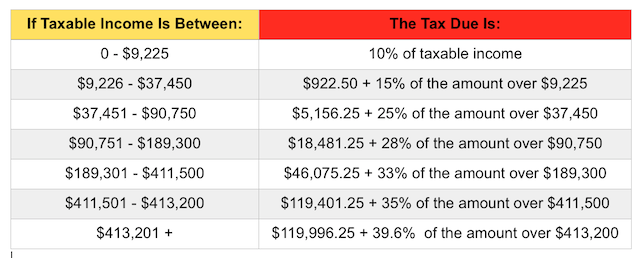
But does America’s extra-territorial taxation system take in any money? If America succeeds with its FATCA and finds ALL of its 8.7 million expat-chattel in the world, how many dineros will it bring to itself? Let’s calculate some examples using IRS tax tables.
53.7% of US expats live in countries which have higher marginal tax rates than USA’s top 39.6% rate. No matter what their income, US cannot tax them up. More than half of the people filing expat taxes should (rightly) owe nothing. Zilch. Zippo.
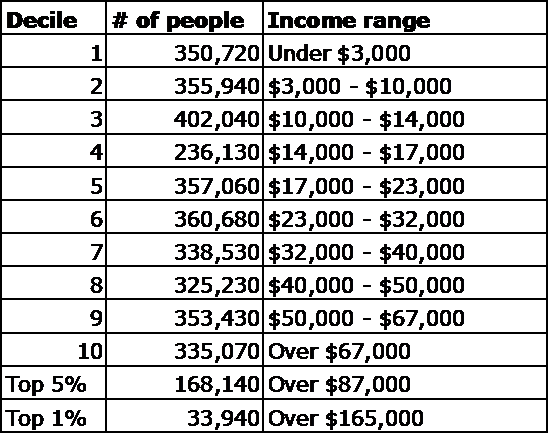
27.4% of US expats live in countries with tax brackets in the 35% to 39.6% region. With USA’s taxing-up method, it could gain a maximum of 4.6% tax (average 2.3%) from the richest of any residents. But a single person must make over $413,200 per year to pass this 35% marginal-tax threshold—however that person can exclude at least $100,000, so a person must make more than $513,200 per year to be taxed in this bracket. The only significant country in this category is Mexico, where 52.3% of the population is below the poverty line and 90% earn less than $33,000 per year. In order for America to get any money out of Mexico, they would have to fleece Mexico’s 1%’er’s . So, in Mexico, more than 99% of the US-expat tax filings would be wasted energy. To know how much money America could squeeze out of Mexico, one would have know the percentage of 1%ers who are dual citizens. The quantity of Mexican US persons to be taxed becomes negligible.
The other cash cows in this category include Algeria, Argentina, Cyprus, Ecuador, Morocco, Norway, Thailand, Turkey, and Vietnam. How many Turks or Argentinians could America fleece? (oops, side point: I forgot to mention that the IRS disallows tax credits for the Norwegian 7.8% tax it labels “social tax”. The IRS wrongly taxes Norwegian residents due to a loophole it wrote into tax treaties and tax regs)
Ok, so we’ve gone through 81.1% of the expat population’s tax returns — and the only thing that has been achieved is that 80.826% have (rightly) contributed no tax revenue to USA and less than 0.274% may have (unrightly) been taxed-up by USA by a tax ranging from 0% to 4.6% of their annual incomes. Oops, I forgot — only 56% of that population are adults. This whopping sum ought to pay for a few dozen aeronautical toilet seats.
I hope that you are beginning to see the ridiculousness of the situation. The GAO has full access to this type of data, and should have been able to calculate this same data. They should have been realizing that the costs of processing millions of returns is ridiculously high in comparison with the ridiculously low revenue potential to be gained from fleecing the 1%’er expats in Algeria, Norway, or Vietnam.
Well, politics is an endless source of black humor. You ought to know that the story just gets more and more ridiculous if one analyzes it further.
America’s extra-territorial US-person-based taxation (CBT) is a big big loser for America. And CBT helps even more to show that the taxing decision makers in Washington are truly a bunch of losers.