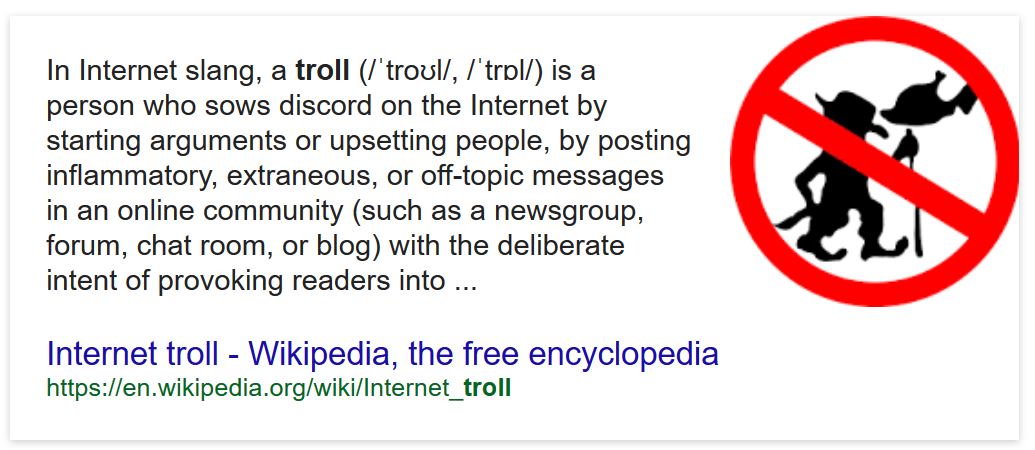
Kinds of Trolls
Typical trolls: These are people who troll for the fun of it. Perhaps they get their jollies out of contradicting others on social media. Perhaps they enjoy arguments with people they disagree with. Perhaps their personal ideology compels them to find people to contradict, like a vegan in a meat-eaters group (yes, I’ve seen this).
Spammers: Spammers are robots or people that leave messages in social media. They post click bait to spread malware or to bring traffic to a website or a product that they are trying to promote. Most often spammers never engage in the discussion, though their comments are designed to look like they are actually interacting with your content: “Hey great post! Thanks for the help.” Or, “Sorry you don’t know how to write. I could give you some pointers to make your website better.” Our spam filter discards hundreds of these messages everyday, but a few manage to get through
Condors: One type of troll is a real person who is dropping by to let people know that he’s got a book for sale or he’s available for business. At Isaac Brock we get compliance condors who are essentially fishing for business. We have had cases where readers here at Isaac Brock have engaged the services of such an expert, only to inform us later that they felt ill-served. So generally, we have mixed feelings about people from the compliance industry: in some cases, they may share arcane knowledge that might be useful for the purposes of this blog. On the other hand, we cannot vouch for their services, and we recognize in some cases these people are able to get what amounts to free advertising at Brock. We have never received a penny from a condor in the form of payment, commission or kickback. The same was not true at the Expat Forum, where compliance condors had to pay to play. At the Expat Forum, however, the condors began to control the agenda, and the forum moderators removed several threads with thousands of comments. Isaac Brock, by contrast, has never received any funding from advertisers, and we only rarely censor comments, and we almost never remove posts.
Astroturfers: The main distinction between the typical troll and the astroturfer is the lack of transparency. Astroturfers troll with a hidden agenda. So for example, a pharmaceutical company may pay an astroturfer to visit social media to defend their products. At Isaac Brock Society we have had cases of astroturfers–one confirmed case, but only because the condor who posted with a second identity lacked the sophistication to use a second IP address for his alter ego. The alter ego of this compliance condor came on to reprimand Petros for his hostility against the condor in an attempt to generate sympathy for himself. Those were in the early days of the Isaac Brock Society. From that day forward, we have been suspicious about astroturfing and have tried to learn more about the phenomenon.
Modus Operandi of trolls especially astroturfers
The astroturfer doesn’t have to use anything approaching a real argument and it is perhaps counter-productive to engage the main points of the original post. It suffices to sow discord and doubt. Sometimes, an astroturfer can take a know-it-all approach while always resting on conventional opinion, attempting to discredit the author through accusations of extremism, lack of knowledge or expertise, or mental instability (such as accusing the author of anger). Because the astroturfer sometimes relies on conventional wisdom, an air of paternalism will replace actual rational debate.
Astroturfers also use multiple identities because one of their main goals is to make it look like their views arise from the grass roots. Hence the name astroturf–it is a fake grass roots movement. Indeed, Adam Bienkov writes:
As reported by the Guardian, some big companies now use sophisticated “persona management software” to create armies of virtual astroturfers, complete with fake IP addresses, non-political interests and online histories. Authentic-looking profiles are generated automatically and developed for months or years before being brought into use for a political or corporate campaign. As the software improves, these astroturf armies will become increasingly difficult to spot, and the future of open debate online could become increasingly perilous.
Who might be astroturfing at Isaac Brock?
Since we do not require that people provide a real name or even a real e-mail address, it is absurdly easy for an astroturfer to assume an alias, create a persona, and begin to post comments. We allow this because it permits people who are intimidated by the IRS to feel the courage to comment. But it isn’t paranoid to believe that astroturfers are also coming to Isaac Brock to sow discord and doubt. We are a true grass roots movement which is challenging the triumvirate of government, finance, and compliance industries. In my own posts in particular, especially by setting down Petros Principles, I have questioned the legitimacy of the triumvirate. Hence, it is in their financial interests to monitor and even astroturf at Isaac Brock Society. We are talking about industries with very deep pockets.
Conclusion
We must always be on our guard. Astroturfers do not reveal their conflicts of interest. Since astroturfers may go to elaborate lengths to create fake identities, we must be suspicious of those who challenge the core of our approach–especially when it is a first time poster (though there may even be some who have been with us for a long time). We should be sophisticated when using social media and never allow astroturfers to sway our opinions.
In my view the burden of proof is on the person who has the alias. I am suspicious of anyone who comes onto this blog for the first time just to contradict me. Therefore, if someone talks like a condor, the burden of proof is on them to prove that they are not one–at least for me. Obviously others have shown that they think that they can trust anyone who comes onto Isaac Brock to contradict Petros–and that Petros shouldn’t expect such people to have to prove themselves. However, anyone who wishes to attack me should at least be as transparent as I am–my blogging alias is a thin veneer over a real person.