
As part of our FATCA IGA litigation in Canada’s Federal Court, Our three Plaintiffs previously provided financial information to the Government lawyers on their accounts. However, Government submitted a motion to compel Plaintiffs to provide additional very detailed financial information.
Transcript of Hearing April 26, 2017 House Committee on Oversight & Government Reform-Meadows
Posted on
by
 Posted in Issues regarding US persons abroad, Law & Morality, Relinquishment, Renunciation, Senate Hearings
21 Comments
Posted in Issues regarding US persons abroad, Law & Morality, Relinquishment, Renunciation, Senate Hearings
21 Comments
Posted in Issues regarding US persons abroad, Law & Morality, Relinquishment, Renunciation, Senate Hearings
21 Comments
 Courtesy of Andrew Grossmann · @andygr
28th May 2017 from TwitLonger TwitLonger
This is a transcript from the FATCA Hearing held in Washington D.C on April 26, 2017.
I think it is interesting to actually read the testimonies that we heard that day. Some of the more striking aspects seem even more shocking and the mistakes stick out like sore thumbs……………..All emphases are mine – Patricia Moon
Hands Down this is the Worst Academic Piece About FATCA ever Written
Small update
Thanks to USCitizenAbroad for posting links re Ms Ran Kim. Here is a piece she is listed on while interning at Caplin & Drysdale in Washington, D.C. (2012-2013, 2014)
Scott D. Michel, Zhanna Ziering & Young Ran Kim, U. S. Offshore Account Enforcement Issues, 16 J. Tax Practice & Procedure 65 (Aug./Sep. 2014).
U. S. Offshore Account Enforcement Issues
We are thinking of Lynne (Blaze)
As many of you know, Lynne (Blaze) has been, from the very beginning, one of our strongest and tireless defenders of the Charter rights of Canadians opposed to our Government’s compliance with the foreign FATCA law. As part of our FATCA IGA litigation in Canada’s Federal Court Lynne acts as the Chair of the Litigation Committee of ADCS.
My sad news is that Lynne is now at the University Hospital in London Ontario. She was in the ICU but has now been transferred out of this unit.
From the hospital Lynne is already sending us emails about her thoughts on FATCA etc. and provided this update on Maple Sandbox:
“Thanks everyone for your positive thoughts. I was transferred last night from ICU to Neurology. Tonight a doc diagnosed me with epilepsy. I do not need that after all the challenges of 36 years of M.S.! She said I will probably lose my drivers’s license.
I was on a ventilator for a few days while I was in ICU–even though my Living Will clearly says no ventilator, dialysis, etc.
I didn’t check my e-mails for a few days and I am just working my way through 98. If you are one of them, I apologize for not responding to you.”
We all wish her a speedy recovery, and it might be nice if you could share your thoughts on this post.
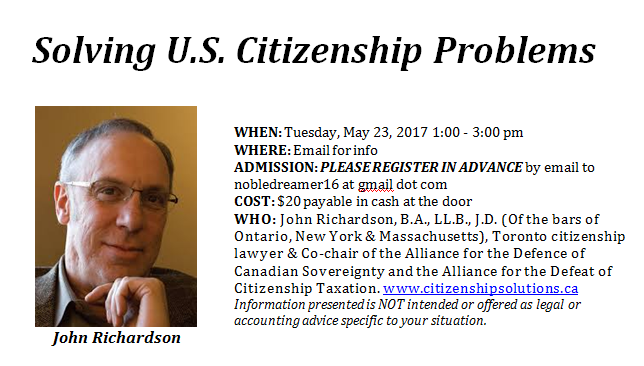
May 23, 2017- Vancouver -Solving U.S.Citizenship Problems
U.S. source-of-interest rules, part one: how the U.S. does residence-based taxation (very badly, with lots of traps)



On Twitter, Andrew Grossman mentioned Housden v. Commissioner, 63 T.C.M. 2063 (1992). Mr. Housden, a partner of famous Canadian architecture firm WZMH, got a loan from the Royal Bank of Canada. He later moved to the U.S. to operate a WZMH subsidiary, and made some payments on the loan from 1980 until 1983 — meaning that RBC earned interest income “from sources within the United States” within the meaning of 26 USC § 871(a)(1).
The U.S. Tax Court ruled that when an individual resident of the United States has borrowed money from a non-U.S. bank, the individual is supposed to be the withholding agent for the 30% tax on interest income earned by the bank under § 871(a). So Housden had to pay that 30% out of his own pocket and try on his own to get it back from RBC. The only relief for Housden was that he didn’t get hit with penalties for underpayment or failure to file required forms, since two famous nests of compliance condors — first Deloitte, later the now-defunct Laventhol & Horwath — failed to warn him about his withholding obligations until he was already being audited.
Brockers with local mortgages or credit cards are probably about to panic upon reading this. Fortunately, the IRS suggested in 1992 regulations that an individual interest payor should probably only be considered a “resident of the United States” if the individual meets the substantial presence test (SPT), regardless of citizenship. As Phil Hodgen pointed out two years ago, the IRS confirmed this view in (non-precedential) Chief Counsel Advice in 2012. So if you have lived in another country for your entire adult life, IRS lawyers do not seem to think they can reasonably interpret § 871 or its regulations to grab 30% of all your mortgage payments.
In other words, this is a tiny island of residence-based sanity in the citizenship-based “Internal” Revenue Code — well, almost. Nothing involving the U.S. tax system can ever be as simple as it sounds.
Irony-“Because it’s the Law” – For once, not applied to non-willful expats but a Citizenship Lawyer
UPDATE – Nov 9, 2018 https://www.canlii.org/en/on/onlst/doc/2017/2017onlsth164/2017onlsth164.html
LAW SOCIETY TRIBUNAL
HEARING DIVISION
Citation: Law Society of Upper Canada v. Lesperance, 2017 ONLSTH 164
Date: August 3, 2017
Tribunal File No.: 17H-025
BETWEEN:
The Law Society of Upper Canada
Applicant
– and –
David Sylvio Lesperance
Respondent
Heard: May 17, 2017, in Toronto, Ontario
Summary:
LESPERANCE – lnterlocutory Suspensions – Based on the evidence: there appeared to have been a misappropriation or mishandling of a substantial amount of a client’s money; the Lawyer was not co-operating with the Society’s investigation; he was no longer in Canada, having left sometime in 2015; the Lawyer had not complied with the Society’s requirement that he disclose his current contact information; and the current location of the Lawyer’s law practice was unknown to the Society – The Lawyer’s licence was suspended on an interlocutory basis.
ON Lawyer remains in Poland as Law Society files notice of motion 4 interlocutory suspension or restriction https://t.co/1m7XIbGikk
— nobledreamer (@nobledreamer16) May 19, 2017
While this particular post is not about a tax-compliance professional per sé, it IS about a person with whom many of us have had interactions and from whom we have been assured we WILL BE CAUGHT in one way or another. Given that, I find it extremely ironic to come across what follows in this post. How many of you who have paid a retainer or left any other type of funds when using a lawyer, ever worry about that person absconding with it?
Continue reading
May 15 2017 Response of some Witnesses [Including those of FATCA supporter Elise Bean] to U.S. House Subcommittee with recommendations to “improve legal framework” of FATCA
[May 18 2017 update: I now include in this LINK the recommendations of Elise Bean, a long-time FATCA supporter and witness at the FATCA hearing.]
On April 26 2017 there was a Hearing at the U.S. House Subcommittee on Government Operations dealing with the harm caused by the U.S. FATCA law imposed on the world.
At the conclusion of the hearing, Chairman Meadows asked the Witnesses for “three recommendations on how to improve the legal framework set up by the Foreign Account Tax Compliance Act” (FATCA).
My personal-only interpretation of this request is that the Chair is saying something like: “If FATCA has to be replaced with something else, can you recommend three compromise laws/approaches that would achieve the “good” aims of FATCA but minimize the harm, and which would receive bipartisan support?”
— I enclose as a link the May 15, 2017 submitted personal recommendations of Jim Bopp, a witness and attorney for the U.S. FATCA/IGA/FBAR lawsuit currently pending in United States Court of Appeals for the Sixth Circuit (I am one of the plaintiffs).
From the Bopp text:
“This letter provides three recommendations on how to improve the legal framework set up by the Foreign Account Tax Compliance Act (“FATCA”).
First, we recommend that any taxation of overseas Americans comply with established United States constitutional principles and international legal norms.
Second, we recommend that the current laws be repealed in their entirety [Bopp goes on to include specifically FATCA, IGAs, FBAR, and citizenship-based taxation] and certain proposals rejected.
Third, we recommend that Congress enact a 1099 requirement on foreign banks, established by treaty, as long as this complies with established United States constitutional principles and international legal norms…”
—- Appended to the end of the Bopp recommendations are my personal thoughts as a separate submission: I support, as does Mr. Bopp, the repeal in entirety of FATCA, FBAR, IGAs, and citizenship-based taxation (the latter to be replaced with territorial/residence-based taxation), do not support any “watered-down” FATCA-replacement legislation whatsoever — which I believe will continue the harm, and offer suggestions on changing U.S. citizenship laws in the very limited context of FATCA harm. In hindsight, I now feel that I should have gone further in my recommendations for citizenship law changes.
—- When I receive the recommendations of strong FATCA supporter Elise Bean, a hearing witness, I will post.
— Ongoing developments: Republicans Overseas has initiated an intensive lobbying campaign with Congress to kill citizenship-based taxation and replace with territorial taxation. There can be no promise of success, but these people are trying. I am not aware of similar efforts on the Democrat side.
May 13, 2017 Canadian Federal Court FATCA IGA lawsuit update: Motion for Summary Trial now submitted
“…The government of Canada has a responsibility to stand up for its citizens when foreign governments are encroaching on their rights…We believe that the deal reached between Canada and the U.S. is insufficient to protect affected Canadians…” June 2015 Pre-Election statement of Mr. Justin Trudeau (now Prime Minister of the Government we are suing) to a constituent
May 13 2017 Canadian FATCA Litigation Update:
SUMMARY TRIAL MOTION has now been submitted on Constitutional/Charter issues. We are finally moving closer to trial and our Vancouver litigators have now served and filed in Canada’s Federal Court a “Notice of Motion for Summary Trial”.
As detailed in this brief motion (see link) this is a pleading to the Federal Court of Canada for a summary judgement we are seeking on the Constitutional-Charter issues.
We argue in the motion that the Canadian legislation enabling the FATCA Intergovernmental Agreement (IGA) violates Canada’s Constitution Act (by forfeiting Canada’s sovereignty and facilitating the extra-territorial enforcement of a foreign state’s taxation and tax compliance regime on Canadians) and Canada’s Charter of Rights and Freedoms (Sections 7, 8, and 15).
Some of you do not consent to be “U.S. Persons”. There is this statement in the Motion:
“The contours of United States citizenship and the definition of US Person are matters of United States law and/or policy and are subject to be changed by the United States at any time.”
There is also this:
“It is a principle of international law that every sovereign state has the right to conduct its affairs without intervention by other states (the “Principle of Non-Intervention”). The Principle of Non-Intervention is at the core of the international legal order and is a corollary of every state’s right to sovereignty, territorial integrity and political Independence. The Principle of Non-Intervention is an element of the unwritten constitution.”
Will the Federal Court of Canada accept this Constitutional argument?
This motion is NOT the main, detailed legal submission (i.e., where all of the case law is discussed, etc.) which will be filed much closer to the hearing date (yet to be decided).
AFFIDAVITS. You will notice on pages 22-23 a long list of affidavit titles. Because of a technical issue related to the litigation, it is not possible to publish the text of these affidavits at the present time.
Some of the affidavits include those we previously submitted and those Government submitted – which we feel will help our case.
There are also expert reports from three witnesses (Ryan Liss, Roy Berg, Kevyn Nightingale) who were selected by our litigators to provide an expert opinion based on our litigators’ assessment of their expertise and experience.
In addition, there are affidavits listed from lay witnesses.
Our litigators made a strategic decision on the selection of specific lay witnesses for the trial from the larger group of volunteers. I thank the lay witnesses and all witness volunteers for their courage and commitment to push for return of Canada to Canadians.
LIKELY NEXT STEPS. On May 19, 2017 there will be a teleconference with Government, Case Management Judge, and our side to deal with the Government Motion to compel further documents from the three plaintiffs (we oppose the motion).
After the ruling, Examinations for Discovery of the three expert witnesses and the plaintiffs will be scheduled and conducted. Our lawyers will likewise examine the Attorney General’s witnesses. It is also possible that the Attorney General might examine our lay witnesses. We currently do not know if they will elect to do so.
Upon completion of the all examinations of the parties, and after filing all required submissions, we will await a trial date to be set by the court. Trial dates are dependent on the availability of Justices and court (backlog) schedules.
I know that the slow pace of our litigation is frustrating. Thank you for your continued support and kind thoughts.
Stephen Kish
Perils & Pitfalls of Being a Green Card Holder

I am posting this comment of Gary Clueit that appeared on the Robert Wood article couple of days ago. Over the past few months, we have “met” Gary on FB, Twitter etc. Especially the Wednesday Tweet Rally- A group that just keeps on giving!!
by Gary Clueit
The article provides a good, if brief, overview of the perils and pitfalls of being a green card holder. The reality is somewhat bleaker.
As a long-term green card holder with no way to escape “covered expatriate” status should I decide the leave the US, I must point out a few of the other insidious side effects of being the holder of a residence permit.
If a green card holder were to decide to leave and relinquish his or her green card, here are some the issues they face in a bit more detail:
Determining the $2M net worth threshold does not cover any assets that the person might have had before ever moving to the US or assets received after taking up residence due to bequests from relatives that have never set foot in the US. The net worth amount signed into law in 2004 and was, I believe, related to the estate tax, despite being less than half the amount of the estate tax (which is indexed whereas the expatriation exit tax threshold is not). Anyone who has diligently saved for retirement and owned houses in San Francisco, Seattle or other major cities over the past dozen or so years can quite easily reach the $2M threshold. It does not make you “rich” by any stretch of the imagination. The non-indexed $2M figure simply appears to be a punitive amount designed to punish anyone for daring to want to leave the US.
Even after paying the exit tax on the “deemed sale” of everything you own worldwide, you will have to pay actual capital gains when you do actually sell since no tax treaty provides a credit for a deemed sale of anything. Outright double taxation. For example, if I own a house in Toronto and sell under normal conditions, I will pay capital gains tax on any profit in Canada. When filing my US tax return I will get a credit for the tax paid to Canada resulting in a single tax bite. However, if I own the Toronto property on the day of expatriation, the US taxes me on any paper profit. Since I have not actually sold the property, there is nothing to declare to Canada’s Revenue Agency (CRA) at that time. When I do eventually sell, CRA will then tax the actual profit, but there is no ability to get a credit from the IRS since expatriation is a terminating event.
After departure and payment of the exit tax, every penny of any bequest or gift you make to someone resident in the US (e.g. a child, grandchild or friend, even if they are not US citizens) is then further taxed at a flat 40%. Because this tax is imposed on the recipient, there is no opportunity to offset estate, wealth or inheritance taxes that might be imposed on the estate of the deceased person by another country even when there is a treaty in effect. Here is where it gets really interesting: assume your net worth is $2.5M on the date of expatriation, you pay the exit tax. Let us also assume that your wealth increases to $250M AFTER you leave the US due to hard work and good luck. If your heirs live in the US (again, whether citizens or not) and you leave all that wealth to them, the entire $250M estate will be taxable to them at 40% regardless of the fact that 99% of your wealth at the time of death was created outside the US and after you had ceased to be a resident. By what stretch of any imagination is this fair or equitable on either the expatriate or their US resident heirs?
Most foreign tax treaties contain tie-breaker clauses to prevent double taxation of those living abroad. However, if a green card holder is living overseas (on assignment, for example) and elects to use a tax treaty benefit to avoid double taxation, that in itself is considered an expatriating act.
I will point out that most of the above situations also apply to US citizens who decide to give up their citizenship, as well as to Accidental Americans who are compulsory citizens simply by being born in the US but who may never have lived, been educated in or worked in the country. The fundamental difference between the citizen and green card holder is that a citizen can only lose their citizenship through the proactive step of filing Form DS-4079. This might at least provide some ability to time events to minimize the tax consequences. A green card holder can voluntarily relinquish their card too. However, a green card holder may be denied re-entry into the US simply by staying out of the country for more than 1 year. Even a re-entry permit, applied for before leaving, is only valid for 2 years and is not be renewable. As a result, a 2 year and 1 month overseas assignment for a green card holder can result in refusal to enter upon return. You then have the alien(!) situation where you are not allowed to reside in the US by action of Customs and Border Protection, but are still considered a US resident by the IRS and still subject to FBAR, FATCA, PFIC, CFC filing requirements and taxation on your worldwide assets. Or at least until you explicitly relinquish the green card or the IRS finds out you are no longer living in the US at which point it becomes an involuntary expatriation and immediately invokes the expatriation regime and tax based on the date you were denied entry back into the US. Why is the ability to time any expatriation important? Take the case of your primary residence. If you plan to expatriate, you make sure you sell your house before that event to ensure that up to $250K profit is not taxable. If you are involuntarily expatriated for any reason, there is no tax break because you have not actually sold the house. The paper profit from the deemed sale will be added to your taxable base subject to the exit tax. When you do sell in the future, you may well be subject to tax on that profit from your new country of residence.
Even while a green card holder resides in the US, they are subject to discrimination. Besides never being allowed to vote (not really an issue since presumably one never desired to be a citizen), they are still expected to pay taxes on worldwide income (not really an issue either since almost every OECD country taxes worldwide income now). The real problems arise in estate planning: