
Interesting Reading below:
http://www.gao.gov/assets/210/209508.pdf
Update, 24 April 2014: As it turns out, Adam Geller of the Associated Press has finally overturned my prediction that you’d never see Davis’ story in the U.S. media; he interviewed Davis for his story “More renounce U.S. citizenship, but deny stereotype”:
When the team’s owner suggested last year that he join Taiwan’s national team, Davis says he found little motivation to keep his U.S. citizenship. “When you think about who I am as a black guy in the U.S., I didn’t have opportunities,” he says. “You get discriminated against over there in the South. Here everyone is so nice. They invite you into their homes, they’re so hospitable. … There’s no crime, no guns. I can’t help but love this place.”
Geller’s story also contains other familiar names. I’m very happy to see that my initial prediction turned out to be wrong, and that the Isaac Brock Society is succeeding in drawing media attention to the real diversity of motivations among people who decide to stop being U.S. citizens.
Here’s another story you’ll never see in the U.S. media about an American planning to renounce U.S. citizenship to naturalise elsewhere: Quincy Davis, a Los Angeles native & Tulane University graduate who left the U.S. in 2006 to join a basketball team in Cyprus, and now plays in Taiwan. Davis applied to naturalise as a Taiwanese citizen last month so he can represent his adopted home in international competitions; United Daily News reported last week that his application is still in progress. After the jump I’ve translated a longer article from earlier last month about his reasons for naturalising in Taiwan, and the issues he faced.
Davis’s case falls somewhere in between the NBC Nightly News myth of “wealthy traitors fleeing the country to avoid the estate tax” and the more common reality of ordinary people who have lived in other countries for decades and are happy to give up U.S. citizenship to become full members of their societies. Davis is certainly well-off, but nowhere near as well-off as the Homelanders who are moving to Puerto Rico and — unlike actual emigrants — thereafter enjoy a complete exemption from capital gains tax on U.S. assets. And moreover, like nearly everyone else who comes to the decision to give up U.S. citizenship, he left the U.S. as a young adult in the course of pursuing success, put down roots elsewhere, and has a dream to keep chasing after he’s no longer a U.S. citizen.
Continue reading
Templeton one of greatest philanthropists in history renounced US citizenship and used his wealth to help mankind! http://t.co/FAhB5lmjk2
— U.S. Citizen Abroad (@USCitizenAbroad) June 23, 2013
The article referenced in the above tweet comes from Sovereign Man and is titled:
US Senate to retroactively punish runaway tax slaves.
Surely, the citizens of the “land of the free” could not be slaves! Surely this thought is “crimethink“!
It’s a “fun article” and makes the following point:
As we’ve reported previously, since around 2006 or so there have been dozens of newspaper reports and many more internet comments about people who renounced U.S. citizenship but never showed up in the Federal Register. However, the Federal Register is not supposed to include just ex-citizens, but certain ex-permanent residents as well: those who held their green cards for eight out of the past fifteen years.
Up until now, the only ex-green card holders I’d heard of weren’t within the scope of the “name-and-shame list”, either because they’d given up their green cards before the list existed (like Taiwanese president Ma Ying-jeou) or didn’t hold them for long enough (e.g. Constitutional Court judge Chen Be-yue). However, in early 2010, Korea.com reported that 2PM member Ok Taec-yeon had given up a long-held U.S. green card so that he could serve in the South Korean army.
Another Korean-language report states that Ok, who was born in Busan, immigrated to Massachusetts with his family at age 12, which would be some time around 2000; it also has a picture of an old yearbook confirming that “Ok Taec-yeon” is his real name and the same spelling he’s been using all his life, so there’s not much possibility he slipped through in the Federal Register list under a different name — no one surnamed “Ok” has ever appeared in the “name-and-shame list”.
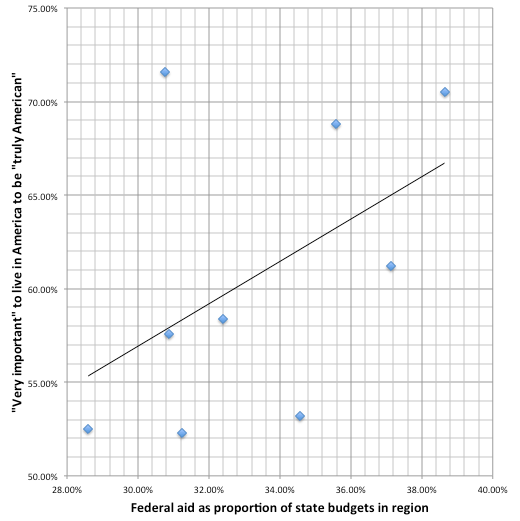
Inspired by a recent TaxProf Blog post showing the percentage of each U.S. state’s general revenue which consisted of intergovernmental revenue (primarily federal transfers) in 2011, I went and re-did the same calculation for each U.S. census region based on 2004 budget data, and graphed it against the proportion of native-born GSS respondents that year who lived in that region as teenagers (GSS question REG16) and stated that it was “very important” to live in America most of your life in order to be considered “truly American” (GSS question AMLIVED). As you can see from the graph, the two variables are somewhat correlated, with an R2 of 0.23.
(Edit: Because I made a data entry error, an earlier version of this post left out the South Atlantic region, which is a major outlier — far more anti-emigrant than their low proportion of federal aid would otherwise predict. Without them in the mix, the R2 would be 0.60).

Pirate Party calls FATCA and Qualified Intermediary program “blackmail”.
http://www.piraten-nds.de/2013/06/03/2329/
At 30.5 Christopher (Chris) Carlson made a short presentation on FATCA on our pirate pulse event. If you could not be there and you are interested in the subject, we hereby provide for you (PDF) its films available.
Direct candidate in WK 42
CC-BY
Also has a follow Christian Szymanek, Direct candidate in WK 42, summarized the issue (Editor’s note: The following translation was commissioned by the author, and made by Dr. C. N. Carlson):
Pirate Party direct candidate for the German Federal Diet, city of Hannover / 2nd electoral district
(Post originally published at Isaac Brock Society on June 4, 2013)
http://www.roberts.senate.gov/public/?a=Files.Serve&File_id=0bc26938-590c-4d20-b573-86f2b31841dd
I couldn’t copy and past the text but read and have a good laugh.
1996 seemed to be a pretty good year to be an American abroad. The U.S. was at the height of its global prestige. The State Department had several years earlier ended its policy of automatically revoking U.S. citizenship from Americans who naturalised elsewhere. And there was little motivation to give up the blue passport anyway: ordinary diaspora wage-earners with non-U.S. retirement accounts and mutual funds ignored all the international financial reporting forms created under the Nixon administration’s Bank Secrecy Act or the Reagan administration’s Tax Reform Act — and the IRS had no complaint because it knew that none of this paperwork could possibly generate more revenue than it would cost to process in the first place.
Yet this benign neglect of Americans abroad was by no means an expression of support. Homelanders were hostile to the idea of an American diaspora: in a national survey, nearly three-quarters of people in the U.S. thought that “living in America for most of your life” was an important part of being “truly American”. This widespread societal consensus on the territorial nature of Americanness was even supported, and supported quite strongly, by a surprising group: native-born Americans who had lived abroad for five years or longer, among whom 85% agreed with this proposition. And over the next decade, this view would only strengthen.
Rejecting US threats, the National Counsil tossed “Lex USA”. The big question now is if the US will follow through with its threats of destroying 18 banks, and how many innocent people will be harmed in the process. Yesterday, Postfinance expressed great fear that it might be the target of US wrath since it is one of the last banks which still accepts US clients living in Switzerland. My best guess is that the US needs to use Switzerland as a scape goat to scare the world into joining FATCA, since FATCA would otherwise fail.
The general view in Switzerland seems to be that if some banks did wrong, then they should be held responsible for their actions without the parliament being involved, while those in favor of Lex USA generally feared the American blackmail.
A lot of commentary that I have read so far in the US seemed to lean more in favor of Switzerland. There were a few calls for war, kicking Swiss out of the US or prohibiting Americans living in Switzerland from having a local bank account, but otherwise many individuals showed an interested in respecting personal privacy and resisting foreign powers.
The votes can be seen here.
This new American chocolate which does not melt is a bit like #LexUSA, containing inside secret materials.
— Marie P Bender (@mariebender) June 19, 2013


