

Baby Elle’s FATCA Letter (Lynne Swanson’s good work)…

Cross-posting while listening to viewing / listening to: http://parlvu.parl.gc.ca/XRender/en/PowerBrowser/PowerBrowserV2/20160414/-1/24805?useragent=Mozilla/5.0%20(Windows%20NT%2010.0;%20WOW64)%20AppleWebKit/537.36%20(KHTML,%20like%20Gecko)%20Chrome/49.0.2623.112%20Safari/537.36
http://maplesandbox.ca/2016/baby-elles-fatca-letter/
Dear Prime Minister Trudeau and President Obama:
Why do you think I am a tax cheat?
I am eight months old. I live with my Mommy and Daddy in Canada.
I can’t walk or talk yet. So my Nana’s friend Lynne is helping me write to you.
At Christmas time Mommy and Daddy opened a small savings account for me in Canada. When I was six months old in February, TD Bank sent me a letter and other stuff.
I can’t read. So Nana read it for me.
I don’t know what the gibberish in the letter means. Nana says it’s crazy. I believe my Nana.
The letter says TD will squeal on me to Canada Revenue Agency (CRA). Then the CRA will tattle on me to U.S. Internal Revenue Service (IRS) for FATCA. What’s a FATCA?
I don’t know what a citizen is. But I’m a double one.
I was born in the United States. My Mommy and Daddy are Canadian citizens. The Canadian government sent me a letter saying I am too. But I have a blue book that says I’m a U.S. citizen too.
TD says because they know I was born in the United States, I have to complete, sign and mail forms to them.
How can I? I can’t even print yet.
President Obama: Why do you want my information? What will you do with it?
Prime Minster Trudeau: Why are you giving your friend Mr. Obama information about me? Why are you helping him? Why aren’t you helping me?
Please help me. I can’t afford an accountant or lawyer from my allowance.
Bye Bye.
Baby Elle
Vancouver Canada

referencing also today’s: http://ipolitics.ca/2016/04/14/baby-girl-drawn-into-cra-irs-information-sharing-controversy/
AND
http://ipolitics.ca/2016/04/14/so-now-the-cra-is-going-after-infants/
…to be continued
Almost no U.S. citizenship renunciation appointments left during 2016 in Dublin; other U.S. embassies also putting up various roadblocks

The website of the U.S. Embassy in Dublin (archive.org — archive.is) is stating that they have “no Renunciation [Sic] appointments available at the U.S. Embassy Dublin from 6th April 2016 until 5th December 2016″. Hat tip: @DavidSShaw13 on Twitter.

So I decided to see whether other embassies & consulates had any similar revelations on their websites, and made tables of the results. These tables cover 175 locations — at least one post in every country where the U.S. State Department has (or had) a permanent physical presence, though not all posts in each country are covered. According to the State Department, the U.S. has “more than 270 diplomatic locations around the world”, though some of these are missions to international organisations or otherwise don’t handle renunciations. These are divided into two groups:
1. A table of links to the renunciation information pages of U.S. embassies & consulates, along with any notable comments on those websites about their procedures (51 entries)
2. A second table of embassies/consulates whose webpages don’t contain any detailed information on renouncing U.S. citizenship nor any mention of how to make an appointment (124 entries, or more than 70% — including twelve embassies to European Union member states).
From my examination so far, Dublin is the only post whose website confesses to a renunciation backlog. However, others reveal they are restricting the supply of appointments to an hour a week or one half-day each month. The rest won’t openly admit their backlogs or scheduling restrictions at all (though we know thanks to Patrick Cain that Toronto has a similar 10-month backlog). And some are deliberately making things even more difficult & time-consuming by demanding a two-appointment process with a two-week wait or longer in between, or telling you to fill out unnecessary forms in quintuplicate, or other such absurdities. (And very few are clear about their procedures for non-renunciant relinquishers, or even mention the word “relinquishment” at all.).
The majority of posts instruct you to email or call for renunciation appointments, and state or imply that they don’t accept online bookings; I find it quite likely that these posts are also silently restricting the supply of appointments. Only a few (for example, Brussels and Seoul) explicitly indicate that online booking (under the “notarial or other services” category) is acceptable. It might actually be easier to get an initial appointment at one of the posts whose websites don’t mention renunciation: since they don’t mention any restrictions on appointments, they can’t object if you just go ahead and book under “notarial or other services”. These posts also probably perform so few renunciations that their staff will have to ask you to come back again for a second appointment so that they can read up on the procedures in the interim & check with their superiors, but at least they might feel too embarrassed to make you wait the better part of a year for the second appointment.
Also see the Isaac Brock Society Consulate Report Directory for first-person accounts of what actually happens during renunciation & other relinquishment interviews.
U.S. State Department tax reimbursement budget for U.S. citizen employees of international organisations up 56% in past decade
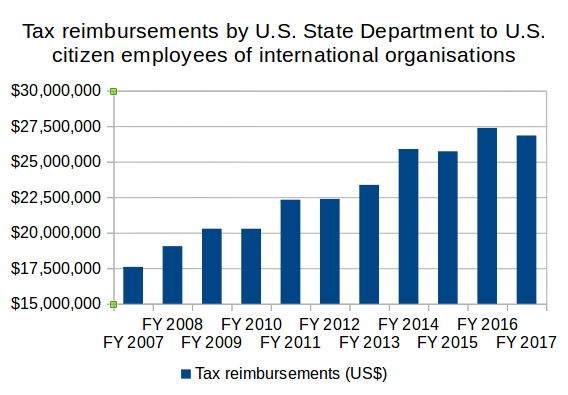 In February, the U.S. State Department published budget requests for the next fiscal year. They estimate that in the current FY 2016 (which ends in September), they will spend US$27.4 million on reimbursing international organisations for those organisations’ reimbursements to their U.S. citizen employees for the U.S. taxes paid by those employees — $9.8 million (56%) more than they did ten years ago.
This is a fast-growing budget item in an area where Congresscritters have been trying to cut back after period of high spending growth in the late 2000s: State officials estimate that their total spending on “Contributions to International Organizations” (CIO) will be only about 12% higher in 2016 than in 2007, and have only requested 7.5% more than 2007 in the 2017 budget.
Fran Hendy and Barrie McKenna see “Panama Privacy Leak” as about more than #offshore witch hunt

cross-posted from ADCSovereignty Blog
Strict tax compliance has its innocent victims /via @globeandmail https://t.co/gj1llKnzgT – Bravo @BarrieMckenna for mention of # FATCA!
— John Richardson – Counsellor for US persons abroad (@ExpatriationLaw) April 5, 2016
The above tweet references the following article by Barrie McKenna of the Globe and Mail. The comments to the article include:
Canada has signed an inter-governmental agreement with the US, implementing FATCA in Canada. As a result, more than 155,000 Canadian tax records were delivered from Canadian banks to CRA, which in September 2015 turned them over to the IRS, circumventing Canadian privacy legislation. Most of the holders of these accounts are ordinary Canadian citizens, whose only crime (as Mr. McKenna notes) is being born in the US to Canadian parents or who otherwise have only tenuous connections with the US. Under the agreement, the Government of Canada plans to turn over Canadian financial information to the IRS annually.
This agreement was implemented by the former Conservative government, over the objections of opposition parties, including the Liberals. Now that the Liberals are in power, they reversed themselves and now insist they have no choice but to obey US demands.
The Alliance for the Defence of Canadian Sovereignty (ADCS) has launched a lawsuit against the Government of Canada, opposing this agreement. The plaintiffs are two Canadian women born in the US to Canadian parents and brought back to Canada age 5 years.
For more information, see the ADCS website: http://www.adcs-adsc.ca/
Are Green Card holders resident outside the USA “US persons” under the #FATCA IGA?
This is an extremely important post because it makes clear that some “US Persons” in Canada, due to holding a green card, have an option to follow the advice of the CRA and not identify themselves as a US Person to their financial institution. This may also be possible in other countries IF a treaty has the same provisions as those discussed in this post and that tax agency has a similar position. Please do check carefully and follow through before deciding whether this can apply to you. And note, nothing in this post can be considered to be accounting or legal advice for your situation.
Without intending it, we seem to have started a new approach to the ongoing problem of having US law inflicted upon us outside the US. I consider this post connected to my recent posts which I will call the “Tax Treaty Series.” Brockers outside of Canada are encouraged to do what we do best; i.e., go and research this to see if people in your countries also have a possibility of utilyzing this information. I think it is undeniable that Brock has had perhaps the largest effect on these issues due to our beginning as a resource tool based upon research. Due to our REFUSAL to believe what we were being told without adequate proof. We have managed to make this situation/people uncomfortable and forced to see that there are other options available than those we are told/offered. No other expat organization as far as I can see, in the last four years, has contributed more. In this spirit, I want to initiate a new effort focused upon looking for “loopholes;” not loopholes in the sense that we get out of doing something. Loopholes where governments have failed to “nail” us to the US’s requirements and by which we may legally NOT follow what is presumed by such governments and the tax compliance industry. I think treaties are an area where we can do more than we have in the past. And I ask for suggestions for a new term – not “loopholes” – what shall we call these? – Patricia Moon
*****
cross-posted from citizenshipsolutions.ca
Introduction …
Circa 2014: Are Green Card Holders who r resident in Canada "US Persons" within the meaning of Canada US FATCA IGA? https://t.co/txcOlpNMfJ
— Citizenship Lawyer (@ExpatriationLaw) April 3, 2016
The above tweet references a comment that was left on Olivier Wagner’s Tax Samurai blog. Olivier is discussing an earlier post of mine called “When It Comes To FATCA, There Are Four Kinds Of Americans Abroad“.
I highly recommend his “post about my post”.
The comments discuss the question of:
Is a Green Card Holder resident in Canada a “U.S. Person”
for the purposes of FATCA?
The last comment notes that the Canada Revenue Agency is advising U.S. Green Card Holders who are resident in Canada that they should NOT identify as “U.S. Persons” under the FATCA IGA.
The exact text of the comment reads:
Green Card holders in Canada are interpreting the following statement from the Government of Canada to mean that FATCA does NOT apply to them:
http://www.cra-arc.gc.ca/tx/nnrsdnts/nhncdrprtng/ndvdls-eng.html
“I hold a U.S. green card. How does this affect my tax residency?
If you are a green card holder (that is, a lawful permanent resident of the U.S.), the U.S. considers you to be a U.S. resident.
However, if you are a resident of Canada for tax purposes and do not hold U.S. citizenship, you should not identify yourself as a U.S. person to your Canadian financial institution.”
The actual IGA is here.
http://www.fin.gc.ca/treaties-conventions/pdf/FATCA-eng.pdf
The definition section includes “U.S. residents” which presumably means tax residents (which in the case of Green Card Holders may be affected by a Treaty election).
The plain reading of the statement on the CRA site will mean that Green Card holders resident in Canada will NOT identify as being U.S. tax subjects.
Note: I tried to leave a similar comment a moment ago, but it didn’t seem to show up. This is a duplicate. Feel free to pick one comment or the other.
– See more at:
http://www.taxsamurai.com/index.php/2014/09/06/four-kinds-americans-abroad-response/#comment-7
The purpose of this post is to expand this discussion …
Continue reading
Assets that will likely result in net taxes paid to US by US persons who have only Canadian source income

Typical investments — the kind the average person makes in planning for a sound financial future — can be rendered pointless or even have disastrous financial consequences due to US taxation of US Persons on income they make in their home country as well as siphoning non-US income out of that country and into the US.
This paper provides concise information on how tax-deferred accounts, mutual funds, and capital gains on the sale of one’s home result in taxes owed to the US. Useful to whip out if anybody tries to tell you that US extraterritorital taxation is no big deal.
Thanks to LM’s hubby, its author.
What is REALLY in the U.S.-Canada Tax Treaty
Read it and Weep… What is REALLY in the Canada-U.S. Tax Treaty https://t.co/5MU3tcvfst
— Patricia Moon (@nobledreamer16) April 1, 2016
The current version of the The Convention Between Canada and the United States of America was signed September 26, 1980.
Since then, there have been 5 protocols to amend the Treaty: 2nd-June 14,1983; 3rd-March 28 1984, 4th-July 29, 1997 & 5th-September 21, 2007.(dates signed)
In Canada, a treaty is not approved per sé by the Parliament. This was somewhat of a surprise to me, due to witnessing the recent chain of events with the signing of the IGA on Feb 5, 2014, watching the (limited) debate process leading up to Royal Assent on June 19, 2014. Given the fact it was very clear the CONs intended to approve it, I had no idea that all they were doing was dealing with the implementation of it. It appears that Canada treated the IGA as if it were a Treaty:
Canada’s Approach to the Treaty-Making Process
After signature of an international treaty, once Canada is ready to be bound by it, a document is prepared establishing that the formalities for the coming into force and implementation of the treaty have been completed and that Canada agrees to be bound by the treaty. More formally, Cabinet prepares an Order in Council authorizing the Minister of Foreign Affairs to sign an Instrument of Ratification or Accession.13 Once this instrument is deposited with the appropriate authority, the treaty is officially ratified. At this point, Canada is bound by the treaty as soon as it comes into force (if it is not already in force).14
In January 2008, the federal government announced a new policy17 to enhance parliamentary involvement in the process by ensuring that all treaties between Canada and other states or entities are tabled in the House of Commons before ratification. The Clerk of the House of Commons distributes the full text of the agreement accompanied by a memorandum explaining the primary issues at stake, including subject matter, primary obligations, national interests, policy considerations, federal-provincial/territorial considerations, implementation issues, a description of any intended reservations or declarations, and a description of consultations undertaken. The House of Commons then has 21 sitting days to consider the treaty before the executive takes action to bring the treaty into effect through ratification or other preliminary measures, such as introducing legislation. The House has the power to debate the treaty and to pass a motion recommending action, including ratification; however, such a vote has no legal force.
One thing that this demonstrates is that Canada most definitely was in compliance with the terms of the IGA on the day it was signed. I am not sure this was known by some members in Parliament. There simply was no need to rush the implementation of the IGA. Why the big hurry? Yet the CONs did this in spite of recommendations to spend more time (as per Prof. Allison Christians, Prof. Arthur Cockfield and John Richardson).
Remember this?
Murray Rankin: Mr. Richardson, in your remarks, you say there’s no reason to rush this through, yet you’ve heard from Mr. Hannah that there would be problems with the 30% withholding tax and the access by banks to the foreign capital markets in the United States. What’s your response to that?
Mr. John Richardson: He’s completely wrong. The obligation is satisfied upon entering into the IGA. That has been done. The agreement states very specifically that it doesn’t take effect until Canada gives notification.
An Extraordinary Debate in the Canadian Senate Part II – The Consultation of the Privacy Commissioner-An Exercise in Futility?
@PLDusseault The Consultation of the Privacy Commissioner-An Exercise in Futility?https://t.co/n60bf3GjvK #StopFATCA
— Patricia Moon (@nobledreamer16) April 1, 2016
Continued from An Extraordinary Debate in the Canadian Senate the Day Before #FATCA IGA Received Royal Assent Part I
The Consultation of the Privacy Commissioner-An Exercise in Futility?
Given the fact that we are expecting a hearing concerning the Privacy Commissioner’s Report (which apparently was not examined before the release of information by CRA to the IRS in September, 2015), I think it is worth revisiting some of the discussions held with the Interim Privacy Commissioner Chantal Bernier prior to the actual implementation of the IGA.
Proceedings of the Standing Senate Committee on
National Finance, April 29, 2014 OTTAWA,
*(2:32-4:16 pm / 4:17-4:39 pm)
*The actual session lasted 22 minutes
also available here, 10:82-89
Senator Callbeck: I have a question on privacy concerns. I understand that some serious concerns are being expressed over privacy. I’m wondering, has the Privacy Commissioner been consulted?
Mr. Ernewein: “… In our discussions with the U.S., we’ve kept the Office of the Privacy Commissioner informed about what we were doing. We’ve also made sure to alert them that the agreement was being signed, to share the agreement with them and to share the draft legislation at that time. It’s my understanding that the Privacy Commissioner does not bless, if you will, government actions or legislation, so I don’t wish to speak for the office or the commissioner, but certainly they have been kept informed of all developments.
****
I have not been terribly familiar with Mr. Ernewein (I only recall him from the HOC May 29 meeting), as my attention during this time was focused on the House of Commons FINA hearings. I suspect that was due to Lynne, John, and Allison testifying there. I was inclined to think Mr. Ernewein was a reasonable fellow until I read this statement. Mr. Shoom furthers this idea a bit later by basically saying that they presumed she had no objections because outside of contact initiated by them, she did not respond further. While seemingly respectful of the Commissioner, even appearing to defer to her, Mr. Ernewein achieves something much more noticeable, which is to say that he doesn’t think it is required for the Commissioner to be on board with the legislation. Perhaps the only requirement is to check with actual Ministers however, how many of them would be as familiar with The Privacy Act and PIPEDA? I guess it wouldn’t matter, since the CONS had a majority. However, it may come back to haunt them later. Ms. Bernier, however understated it may seem, made some strong points that suggest she had serious concerns about the IGA.
President Announces new “Gross Taxable Product (GTP)” national economy statistic


The President declared: “Gross Taxable Product (GTP) shall replace GDP as the statistical measure of the U.S. economy” at 12:01 a.m. EDT today, April 1, 2016. “During 1991, the Republicans lowered the statistical value of the United States Economy by switching from the GNP measurement to the less-favorable GDP measurement. At no other time in history had any government official lowered the measurement of the perceived U.S. economy so drastically and made the government look so bad. The action I am taking today will more than recover from those damaging policies of the past, and make the U.S. economy to appear as taking an immediate $3 trillion jump in perceived performance”.
Most pundits responded quickly and positively to the move. MSNBC has been reporting that the announcement reverses the criticisms the President once received after having said that the United States is not exceptional. “No other country in the world measures their economy this way. Measuring the economy by the performance of its taxed individuals is something that no other country has ever done before. This is truly an exceptional announcement–contrary to what critics have been saying for so long”.
Fox News pundits immediately cast a less-than-positive light upon the announcement. “This is not the type of decision that should be made by a lame-duck president. This decision should have been put off until someone is in office who is much better at spending Americans’ money.”
Continued here in today’s special edition of The Rag
