FATCA: Breaking through Fear with a Swiss Referendum
October 16, 2013
From: Bilan, Switzerland
By Mohammad Farrokh
The Swiss are likely to vote to overturn a FATCA agreement with the US Treasury Department, which has recently been ratified by Parliament. On October 8, a STOP-FATCA referendum committee has been set up, amid skepticism and fears of US reaction. Direct link to access the referendum is here
[Note: FATCA (Foreign Account Tax Compliance Act) is a law requiring Swiss Banks to transmit the financial data of US expatriates, as well as many Swiss citizens, to the IRS. Original French (translated by Victoria Ferauge): Money & Finance “FATCA: un référendum pour briser la peur”] Continue reading
FATCA and Canadian Investment Advisors
http://www.investmentexecutive.com/-/your-american-clients-and-the-irs?redirect=%2Fsearch
While canadian financial services institutions scramble to prepare for the new U.S. law that requires them to report on accounts held by their American customers, those clients may need a helping hand now.
The new regime starts next summer. For the estimated one million Americans in Canada, this new law means it will be almost impossible to remain off the radar of the U.S. Internal Revenue Service (IRS) any longer. As a result, your American clients may be panicking and in need of advice and reassurance.
That’s also partly because many such clients have been in denial for some time. But that denial is now a recipe for trouble. “For people who aren’t filing [their U.S. tax returns and] thinking, ‘I’m a small fish; they’re never going to get me’,” says Christine Perry, a lawyer with Keel Cottrelle LLP in Toronto who specializes in cross-border tax law, “I think that’s just a naive way of looking at it. Their accounts will be reportable accounts, and banks will turn over all that information to the [IRS].”
Bye America, I feel so free!
The following is a translated portion of a German song. I replaced the word “woman” with “country”. Nothing is complete without a good song to go along with it!
[Intro]
This was by far the worst week
That I ever had in my entire life
I don’t know if I should stand up
I have no plan on what I should do
Because somehow everything is crappy
Never before was I so far down on the ground
Because I know that my entire savings are gone
And my country has betrayed me!
Uuah, Whatever![Hook:]
Bye (bye), I feel so free (free)
I don’t want to go back home
And I don’t give a damn shit about tomorrow
I lift a glass and scream:
Bye (bye), I feel so free (free)
I don’t want to go back home
And I don’t give a damn shit about tomorrow
I lift a glass and scream[Part 1:]
Now I am so free (free)
And I stand up again
I am alone and I scream
Go out again
Jump in the nikes, fly
Happy Anniversary Ambassador Jacobson – Thanks for introducing me to Canada Grandmas
Today is October 18, 2013. Exactly two years ago today Ambassador Jacobson made his infamous Canadian Grandmas speech. I think we should pass and ask a question that Ronald Reagen might ask:
Are you better off today than you were two years ago?
What follows is one of many Ambassador Jacobson posts that appeared (November 21, 2011) on the RenounceUScitizenship blog.
What’s U.S. expat to do? Time for the IRS to generate trust!
Can the IRS be trusted?
“When I read all of this I was concerned. So last week I called the Commissioner of the United States Internal Revenue Service to see what we could do. I explained the problem to him.
The result is that both he and I are sympathetic to the concerns. We are going to work together to see if we can’t find a way to accommodate grandma — and others — here in Canada. But we have to figure out a way to do it without letting the person who is trying to evade taxes in the Cayman Islands off the hook.
My message on this one is to sit tight. We are not unreasonable. We are not unsympathetic. We are not irresponsible.”
New Zealand FATCA IGA update: IRD deems Kiwis with U.S. Connections as “US taxpayers habitually resident in New Zealand!”
For a country which has a history of resisting American imperialism, i.e., banning the U.S Nuclear powered Navy from its ports, times have changed.
Today, New Zealand is moving steadily by stealth towards passive acceptance of a FATCA IGA. It gets no media coverage, and has no visible, on the ground, opposition. Nothing concerning the detrimental impacts of FATCA has broken out in public media, and I think it is fair to say, that Kiwis generally have no idea what is happening (not withstanding Osgood, Moby and Pukekonz comments on IBS). Continue reading
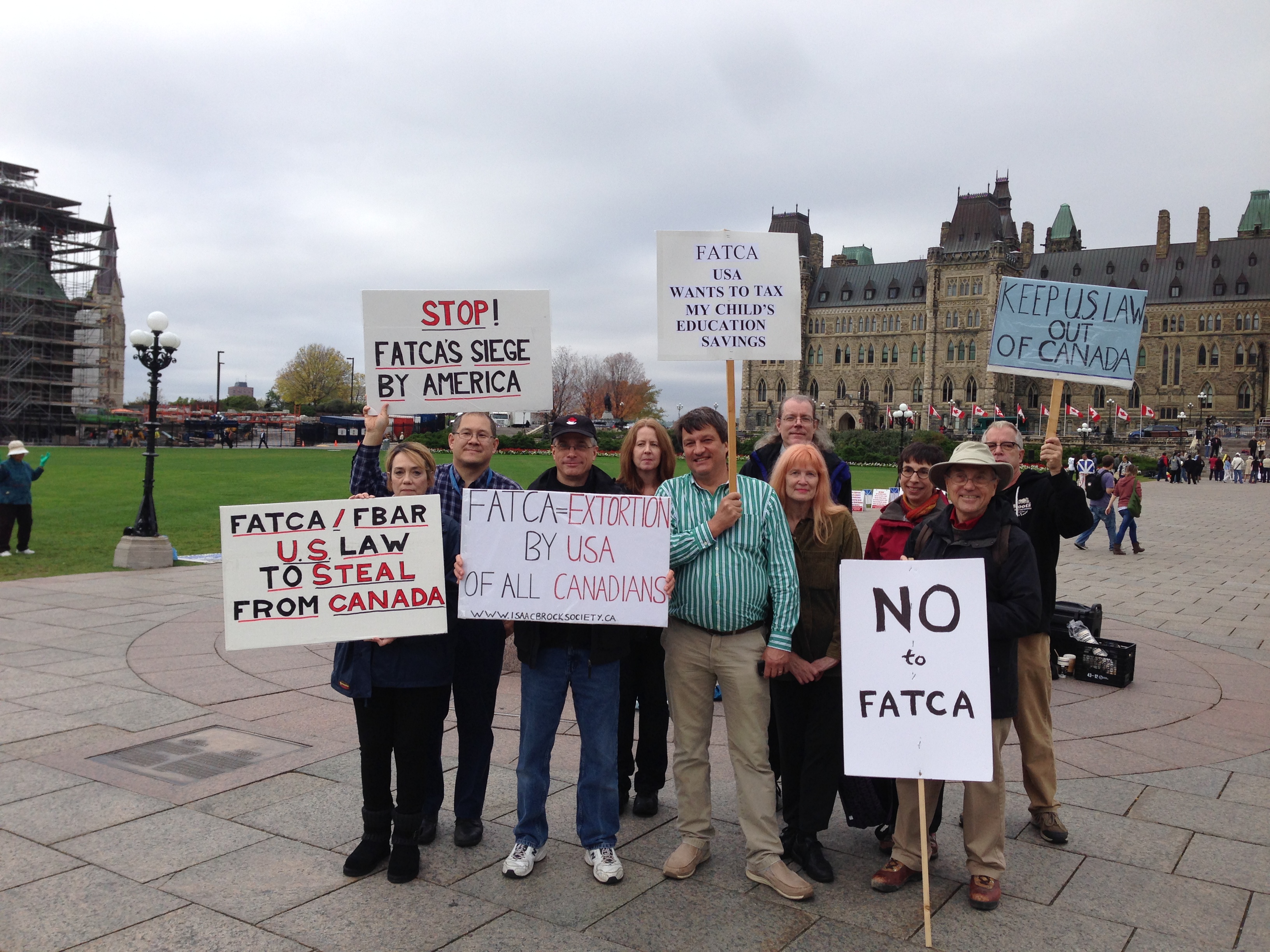
It’s Time For A Second Canadian Anti-Fatca Protest ! UPDATE! Parliament Hill – Oct 16th!
French Finance Minister Moscovici STRONGLY endorses FATCA
Gary Wright: Welcome to the IBS Wall of Shame #FATCA
http://www.bissresearch.com/blog/fatca-the-end-of-the-beginning/105
FATCA is still with us. Looming over financial services like a great big Golden Eagle, it has been gliding on the hot air of dissension for a few years, but make no mistake the FATCA bird is going to swoop down soon.
Like all regulations which cause industry wide change, FATCA has been taking hits from various jurisdictions around the world, which is the normal response from the finance industry when it comes up against the requirement to invest in technology developments that do not have an obvious business benefit. The tactic is always to rebound back to the inflicting authorities with a myriad of reasons why the laws and rules cannot be implemented, in the hope and expectation that the authorities do not know enough about the market mechanisms or technology to know any different. This has certainly been the case with many regulations that the rest of the developed world has been forced to adhere too. Implementing a global regulation is always a tough call, but in the current economic environment one that had very little chance of being waved through unopposed.
However, the issues that the financial world has with FATCA should not dull the appetite for this regulatory requirement not to be enforced by the revenue authorities across all markets. Indeed the UK has been adopting FACTA like positions already and a UK version of FATCA will no doubt emerge sooner or later. Quite right too in my opinion.
In fact all financial markets worldwide should be made to comply with FATCA, as a kind of test model for a similar requirement to be introduced by their own revenue authority. It is in this way that a global net can be created enabling tax avoidance by the rich and criminal to be eradicated. It’s a small price to pay for financial services firms to buy into the FATCA type projects, which should be viewed as an international development not simply by the will of the USA.
I find it hard to understand the resentment that FATCA has engendered, when in truth it’s a vital piece of tax management that only jeopardises the criminal. The financial markets have to ensure that they are seen as strong and resilient by working with government tax authorities for the good of all.
Isn’t this a good PR job for the financial services industry to undertake for the benefit of society?
Nestmann – Why Have So Many Americans Considered #Expatriation?
Why Have So Many #Americansbroad Considered #Expatriation? It’s Probably Not What You Think… http://t.co/wByZ2Mulwf
— U.S. Citizen Abroad (@USCitizenAbroad) October 15, 2013
So, while the media sound bytes tell you that expatriation is all about tax, don’t believe it. Sure, that’s a part of it, but the reality is much more complex.
My own experience with expatriated clients backs this up.
- One who had lived in Switzerland for more than 40 years gave up her U.S. citizenship only after all of the banks she dealt with there closed her accounts. They didn’t want to deal with all the reporting requirements the USA requires if they accept U.S. account-holders. It’s easier just to fire their American customers.
- Another client received a letter from the bank that had issued a mortgage years earlier for her home in Germany. The letter threatened to cancel her mortgage unless she could prove she was no longer a U.S. citizen. Rather than face a huge balloon payment, she gave up her passport.
- A Canadian client contacted me after receiving a bill from the IRS for $20,000, despite being (he thought) 100% compliant with all U.S. tax and reporting obligations. He’d even hired a big-name U.S. accounting firm to prepare his tax returns each year, at a cost of more than $5,000 annually. He never owed any U.S. tax because taxes in Canada are higher than in the USA, but he still got screwed. It appears a Canadian educational savings plan account he’d set up for his daughter was the problem. Under Canadian law, gains in the account are tax-deferred—but not under U.S. law. That led to a big tax bill—and his decision to expatriate.
The fact is, more than 7 million Americans now live abroad. Many of them can no longer hold bank accounts, qualify for a mortgage, or set up a tax-deferred account for retirement or their children’s education.