
Interesting video. Shipping Canadian jobs to America.
Interesting video. Shipping Canadian jobs to America.
Update
These seminars will include discussion and analysis of the IRS “relaxed opportunities” for people to come into compliance.
Solving US Citizenship Problems Information Sessions
U.S. Citizenship and Young Adults: Navigating The Special Rules Imposed On U.S. Citizens Abroad
From the CRA website (FAQs– FATCA):
6. Will my financial institution be asking me if I was born in the U.S.?
A financial institution complying with the Agreement will not be required to ask its account holders about their place of birth.If a financial institution, applying the due diligence rules of the Agreement to its accounts, discovers any records connected to the account that have an unambiguous indication of a U.S. place of birth, the financial institution may treat the account as a reportable account or follow up with the account holder to obtain documentation that shows the account holder is not a U.S. resident or U.S. citizen.
A recent posting to IBS from BC Doc (from around the same time the servers went down):
RBC Direct Investing: The US Persons Round-Up:
I was helping a family member open an on-line investment account with RBC Direct Investments today. I couldn’t help but notice the many different ways RBC DI is trying to identify so-called “US Persons.”
Here are the questions asked by the on-line application:
Are you a U.S. Citizen or a U.S. resident for tax purposes?
If you answer yes, the next prompt is:
To comply with regulations, you will be presented with a W9 form with your application package.
Enter your US Social Security Number (SSN).
If you answer no, the next question is:
How many countries are you a resident of for tax purposes?
You are then asked:
Country of residence for tax purposes.
Next up is:
Enter your City of birth.
Followed by:
Enter your Country of birth.
Next up is:
Are you, the co-applicant, a U.S. Citizen or a U.S. resident for tax purposes?If you answer yes, you are prompted to enter your US Social Security Number (SSN).
You also get the statement, “To comply with regulations, you will be presented with a W9 form with your application package.”
If you answer no, the next prompt is:
How many countries is the co-applicant a resident of for tax purposes?This is followed by:
Co-applicant’s country of residence for tax purposes.
Co-applicant’s city of birth.
Co-applicant’s country of birth
Are you married or do you have a common-law spouse?
Is your spouse the joint applicant?
I think we can consider this a sign of things to come from Canadian banks and investment firms in the coming months. Forewarned is forearmed.
One more thing. A W-8BEN for is a part of the package. RBC-DI requires completion of the W-8BEN form so that Canadian citizens are given the more favourable 15% tax withholding by the US on their dividends (versus the standard 30% I believe if a W-8BEN is not completed). New on the W-8BEN are two questions:
City of Birth
Country of Birth
I have banked with RBC-DI since 2007. Prior W-8BEN forms did not ask city and country of birth.
The net has been cast!
My questions for today:
Why is RBC DI asking for country of birth if this information is not required by CRA?
If this information is not required, is it illegal for RBC DI to ask for it?
The questions about city of birth and country of birth on the W-8BEN appear to have been added by RBC DI. I don’t see these questions on the official IRS version of the W-8BEN.
Again, if this information is not required, is it legal for RBC-DI to ask?
We used to call the USA the land of opportunity. But with FATCA, the USA has become the land of importunity.
The US is forcing all the banks in the world to give them banking information. To say this is an importunate demand is a bit of an understatement.
George brings this to our attention:
The UK Government worked to include language about discrimination in the FATCA IGA.
j) The Financial Institution must not have policies or practices that
discriminate against opening or maintaining accounts for individuals
who are Specified US Persons and who are residents of the UK.
But was that nothing more than window dressing?
Bloomberg reports that the US plans to fine a French bank US $10 billion:
U.S. authorities are seeking to impose the fine to settle allegations that BNP transferred funds for clients in violation of sanctions against Sudan, Iran, and Cuba, according to people familiar with the investigation. The fine could be the largest criminal penalty in the U.S., eclipsing BP Plc’s $4 billion accord with the Justice Department last year.
I have little sympathy for banksters and politicians who are essentially arguing over how they going to divide the spoils of the middle class. But this $10 billion fine of France is a particular arrogant treatment of an “ally” and has the potential of helping the anti-FATCA movement. It is an especially egregious example of how the US determines that its laws have international jurisdiction and has set about confiscating the world’s wealth through its banking hegemony. If the US keeps this up, expect the rest of the world to join Russia and China economic coalition against the US.
Hat tip, Zerohedge: France Furious At US $10 Billion BNP “Masterful Slap”, “Racketeering” Fine
We’ll be getting together for lunch Saturday, 7 June, at 1:30 pm at the Flying Banzini, 1242 Wellington Street West, Ottawa. The Flying Banzini specialises in sandwiches and desserts and there’s plenty of on-street parking.
Hope you can make it! Please rsvp by posting a comment here or e-mail me at pacifica.isaacbrocksociety@gmail.com
A simple data mash-up I’m surprised I’ve never seen before: number of high-net-worth individuals (HNWIs) vs. number of people who bought a U.S. green card through the EB-5 investor visa programme in the past five years, by country or region. The former number comes from Capgemini’s 2013 World Wealth Report (WWR), specifically the section on HNWI population estimates; the latter number comes from the State Department’s Report of the Visa Office, specifically Table VI, Part IV for each year.
| How many HNWIs in each country or region obtained EB-5 green cards in 2009–2013? | |||
|---|---|---|---|
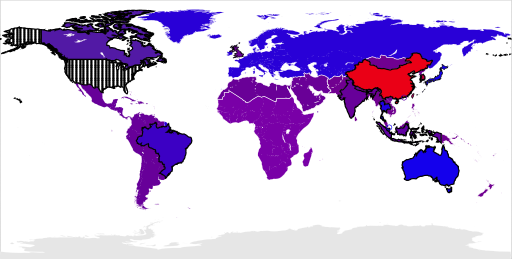 |
1 in 29 | ||
| 1 in 64 | |||
| 1 in 128 | |||
| 1 in 256 | |||
| 1 in 512 | |||
| 1 in 1,024 | |||
| 1 in 2,048 | |||
| 1 in 4,096 | |||
| 1 in 8,192 | |||
| 1 in 11,643 | |||
Note that except for certain countries, the WWR only provided estimates of HNWIs on a regional basis. The above map was thus coloured in by taking the total of EB-5s for the region and dividing it by the number of HNWIs; this means that some countries in the map are coloured in according to the average for the broader region, even though no one at all from that country got an EB-5 in the five-year period in question. Where the WWR did provide a country-specific estimate of the number of HNWIs, the country is outlined in black, except for Hong Kong and Singapore which are circled.
Well, I hope that our technical problems have finally come to an end. Problems Wednesday were about changing our domain registration to a new ISP (internet service provider), which required time for “prorogation”. I myself didn’t have access until Thursday morning. Then the normal Brock traffic simply overwhelmed our shared server service which was promoted by the ISP but turned out to be thoroughly inadequate for our needs. That’s when we started getting the account suspended message–and no, that wasn’t because you put some bad language in a comment. So we had to change to a new platform which is more robust and will hopefully carry us into the next year.
For those naysayers of Isaac Brock–and boy do we ever have them, I have a message. Take for example Kim Moody, who wrote:
I’d been meaning to post this earlier, but the Government Accountability Office produced another OVDP report in February: “IRS’s Offshore Voluntary Disclosure Program: 2009 Participation by State and Location of Foreign Bank Accounts”. This was in response to a request by Carl Levin, and follows up on their previous demonisation of people who don’t want to enter the OVDP.
Naturally, most media sources noticed only the high-profile facts that Carl Levin & the GAO want them to: OVDP participants are located in high-income states and many of them had Swiss bank accounts. Forbes, for example, ran it under the sensationalistic and deeply-misleading headline “Where Offshore Tax Evaders Live and Bank”. However, as we’ve repeatedly emphasised here at the Isaac Brock Society, the major effect of the OVDP has been to terrorise minnows with personal connections to foreign countries — immigrants, emigrants, and their spouses and children — who innocently organised their financial lives around their personal connections.
A bit of digging and calculator work with the GAO’s latest report offers even more evidence to support what we’ve been saying here all along. The U.S. states with the most OVDP participants were precisely the states with the highest foreign-born population. And besides Switzerland, the countries where most OVDP participants had their bank accounts were precisely those countries where high proportions of American emigrants have gone to live or those countries whence high proportions of foreign workers in the U.S. have come.


