One year ago I had the pleasure of joining John Richardson, Tricia Moon and Bahmen Yazdanfar on That Channel.
(7) An unjust law is no law.
Commentary:
Lex iniusta non est lex has a long tradition going back to St. Augustine. The world’s greatest human rights heroes remind us that unjust laws are illegitimate.

Unfortunately, in today’s Western world, lawmakers, law enforcers, and victims need reminding that an unjust law is no law. People are essentially law-abiding often to the point of scrupulousness. Civil obedience has become second nature, since the majority of us ordinary people start with the assumption that government is benevolent.
The cross-border compliance condors have taken advantage of this essentially law-abiding character. They try to infect their clients with a kind of tax scrupulosity, a pathological guilt and fear that if they do not do exactly as told, the IRS will destroy them with taxes, fines, interest, and jail time–and it would be the client’s own damn fault because it was their duty as a citizen to keep up with the requirements of the IRS.
My writing at the Isaac Brock Society has often focused on the injustice of the laws and their application to expats. This articulation of the injustice has been of clear benefit to our readers, if only to confirm that it is the USA Federal Government that has become criminal and that their own innate sense of what is unfair was right all along.
Why is the IRS persecution of expats unjust? Here are some ways that have been explored over and over at the Isaac Brock Society:
Previous discussions:
Civil Disobedience, FBAR and Forms 8854 and 8938
California genocide and the Indian Tax Revolt of 1851
Fair tax, unfair tax: or When is it paying my fair share?
Burning down barns is not wrong because it is illegal; it is illegal because it is wrong
When law becomes a substitute for morality
Previous Petros Principles:
(1) What the IRS can’t know unless you tell them can’t hurt you.
(2) Fear makes the IRS more dangerous than it really is.
(3) Haste is the devil
(4) Those most hurt by the IRS’s persecution of expats have engaged the services of cross-border compliance condors.
(5) Those least hurt have done nothing.
(6) Home is where you live.
About: Petros is the alias of the founding administrator of the Isaac Brock Society. Petros Principles are guidelines that have helped him and others deal with the United States’ world-wide tax invasion.
(6) Home is where you live.

Commentary:
After the American Revolution defeated the British, the Loyalists to the crown fled–many of whom settled here in Ontario where I live today. The Americans seized their property in the US. The early Americans looked askance at those whose loyalties were stronger for their mother country than it was for the new homeland.
Now the situation is reversed and the USA requires Loyalist-like patriotism from its expats around the world. Yet I have found that the one of the major principles that has guided my actions in this IRS persecution of Americans abroad is that home is where I live–not where I come from. My instincts tell me to protect this community, the people who are near me.
American exceptionalism may require that I consider the USA my home. Indeed, sometimes when I passed the border, the US border guard would say, “Welcome home!” Each time I crossed the border, however, it felt less and less like home, and when finally I read about certain expectations that the USA had upon me and my family here in Canada, I realized that the USA had become foreign and hostile. My home is now here. It has been for quite some time.
Previous discussions:
Homelanders Abroad at American Expatriates Facebook Group
Homelanders Abroad are drawing lines in the sand
Who is the real Peter Dunn?
Previous Petros Principles:
(1) What the IRS can’t know unless you tell them can’t hurt you.
(2) Fear makes the IRS more dangerous than it really is.
(3) Haste is the devil
(4) Those most hurt by the IRS’s persecution of expats have engaged the services of cross-border compliance condors.
(5) Those least hurt have done nothing.
About: Petros is the alias of the founding administrator of the Isaac Brock Society. Petros Principles are guidelines that have helped him and others deal with the United States’ world-wide tax invasion.
(4) Those most hurt by the IRS’s persecution of expats have engaged the services of cross-border compliance condors.
(5) Those least hurt have done nothing.
Commentary:
I have heard many expat stories. A clear picture emerges. Many of those who wish to do the right thing have paid dearly. In some cases, the victims pay little if any taxes, but large payments to their cross-border tax accounts and lawyers. In the most extreme cases, people have followed the advice of their cross-border lawyers and have entered OVDP “amnesty” programs. Those in amnesty programs have had not just money but years sucked from their life–what Just Me (Marvin van Horn) called LCUs (Life Credit Units).

On the other hand, I know some people who have done nothing: they haven’t renounced, and they haven’t complied. But above all, they have informed themselves rather than seeking the services of a wraith. This method obviously works best if (1) you are not on the IRS radar; or (2) you do not meet the income threshold (such as non-earning spouses of a non-US persons). For these people, it is life as usual. (I understand that in some European countries bank accounts have been closed–obviously if that bothers you, you will likely have to do something–i.e., renounce or return).
I heard once that standard operating procedure in the compliance industry when asked by a client how much this whole fiasco would cost, is to ask back: “How much do you have?”
Previous Petros Principles:
(1) What the IRS can’t know unless you tell them can’t hurt you.
(2) Fear makes the IRS more dangerous than it really is.
(3) Haste is the devil
About: Petros is the alias of the founding administrator of the Isaac Brock Society. He has created this series of Petros Principles as a means of communicating guidelines which he believes have helped him and others deal with the United States’ world-wide tax invasion.
(3) Haste is the devil
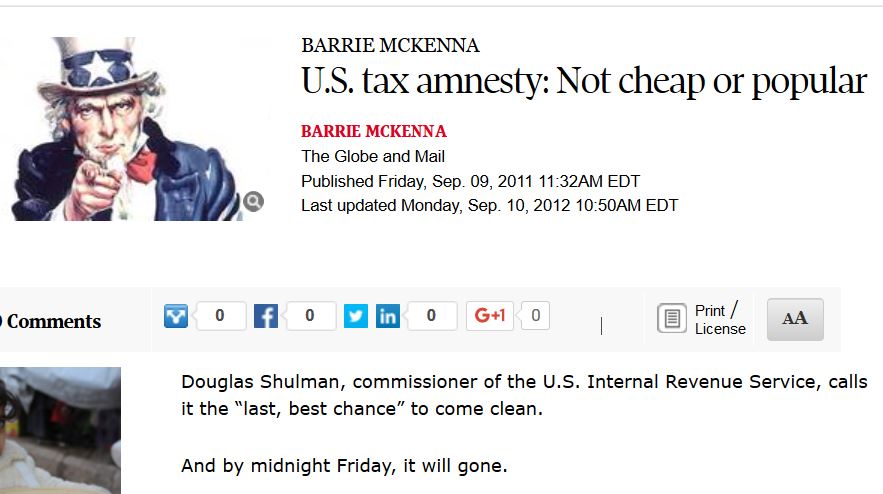
Commentary: In years circa 2009-2011, Barrie Mckenna of the Globe & Mail and other writers in major Canadian newspapers reported that the Overseas Voluntary Disclosure Programs were going to end and that people better hurry up if they want to “come clean”. Here is an example of the scaremongering that took place:
(2) Fear makes the IRS more dangerous than it really is.
He sees you when you’re sleeping,
He knows when you’re awake.
He knows when you’ve been bad or good,
So be good for goodness sake!
Commentary: The IRS is not omniscient and omnipresent like Santa Claus. As much as the US government has tried to take away the privacy of expats, it has only very limited powers even with the betrayal of our local governments on FATCA. It is possible in many cases to work around these limited powers.
The first step in protecting oneself from the IRS stripping you of your universal human rights is a sober and realistic assessment of its true power. Many if not most of us who are living outside the USA are relatively safe because the IRS’s powers of seizure, subpoena, and liens are limited outside of USA borders. Moreover, the IRS has an insufficient audit and enforcement personnel to hunt the much bigger and easier game in the Homeland. Even if it could go after us, it would be an inefficient means of increasing revenue.
A better metaphor for the IRS is a roaring but toothless lion and not Santa Claus.
Inordinate fear of the IRS is dangerous because it has caused some people to lay down all of their normal defense mechanisms and like an innocent lamb to stand paralyzed before the toothless lion.
One of the major roles of the cross-border compliance industry has been to frighten their clients and the public about the IRS’s power, and the media has too often created panic by consulting the compliance industry as their principle experts for information on US expat tax issues.
Previous Petros Principles:
(1) What the IRS can’t know unless you tell them can’t hurt you.
About: Petros is the pen-name of the founding administrator of the Isaac Brock Society. He has started this series of Petros Principles as a means of communicating guidelines which he believes have helped him and others deal with the United States’ world-wide tax invasion.
(1) What the IRS can’t know unless you tell them can’t hurt you.
Commentary:
A common mistake in dealing with government bureaucracies is fastidiousness. This is more likely to happen if you engage a tax compliance condor than if you prepare your own taxes.
For example, the IRS requires that a US taxpayer in Canada report TFSA (tax free savings accounts) and RRSP (Registered Retirement Savings Accounts)–which have been excluded from FATCA reporting requirements in the IGA negotiated with the government of Canada. There is therefore no way that the IRS can know about these accounts, and I would not report them unless one has already declared them to the IRS.
If you engage a condor (a cross border accountant or lawyer), she will likely require a fastidious obedience to the most up-to-date IRS bulletins and Internal Revenue Manuel rulings, etc. You may have to argue with them in order to not report something. I recognize that this may create a war.
About: Petros is the pen-name of the founding administrator of the Isaac Brock Society. He has started this series of Petros Principles as a means of communicating the guiding principles which he believes have helped him and others deal with the United States’ world-wide tax invasion.

Ben Steverman, a reporter for Bloomberg (New York), is preparing a personal finance article on special tax issues that expat lambikins face as they file US taxes from outside the jurisdiction of the USA. He understands these lupine tax obligations have become increasingly aggravating and expensive.
Interested lambikins should contact him before Monday when he hopes to conduct his interviews. He can be reached at his bloomberg.net email address, (bsteverman@).
On February 28, 2011, I stood up with dozens of other people and made an oath of fealty to the Queen of Canada. At that moment I ceased being a US citizen because I made my oath with the intention of relinquishing US citizenship. As of yesterday, it has been five years. Rejoice with me. It is a cause of celebration.
It was in February, 2010, that I made the decision to seek Canadian citizenship. I had been eligible to apply for it for years, but it was upon learning about the exit tax on those who renounce US citizenship that I felt compelled. If the USA was going to tax me for exiting with more than 2 million in assets, I’d better quit now before I get that wealthy. I needed the protection of the Canadian government that citizenship could provide–and I did not want to become stateless because of renouncing US citizenship. While I am happy to have become a Canadian citizen, the Canadian government has disappointed through refusal to protect so many citizens whose clinging attachment to the USA remains an impediment to their true happiness. Hence, the fight continues, even if for me it is mostly solved. So my joy in February 28 as special day is really and truly in my having on that date cast away the attachment to the USA. I consider my CLN a Certificate of Manumission. But as can be seen by the timeline, I have to wait until 2018 before I will be free from FBAR.

Here is what I am thinking of submitting to my bank manager. Please note one small change that I made from Stephen Kish’s template highlighted in boldface:
Dear bank manager,
I am a customer at your bank and have several personal and business accounts, as a well as self-serve trading accounts at your discount brokerage.
I understand that on September 30, 2015 Canada CRA turned over private banking information on 155,000 accounts to the United States Internal Revenue Service (IRS). Your bank also provided some of this information.
Please tell me whether your bank passed on any of my banking information to CRA for the subsequent transfer of the data to the IRS. I think it is very possible as I was born in the United States and may have presented my US passport as a form of identification when I opened some of the accounts.
I need this information in writing by ASAP so that I can prepare my family for the impact of having the IRS know everything about our bank accounts..
If you are unable to comply with my request, would you please kindly provide your reasons?
Thank you and always a pleasure,
Petros