
On July 2 2014 my understanding is that Canada’s banks will be asking (at least) new account holders questions and employing a variety of approaches to establish U.S. personhood. These questions will violate Canada’s Charter Of Rights and other laws. Many of us also wonder whether the Silent Majority out there feels that such questions have no consequence.
Coming to a Canadian bank near you?
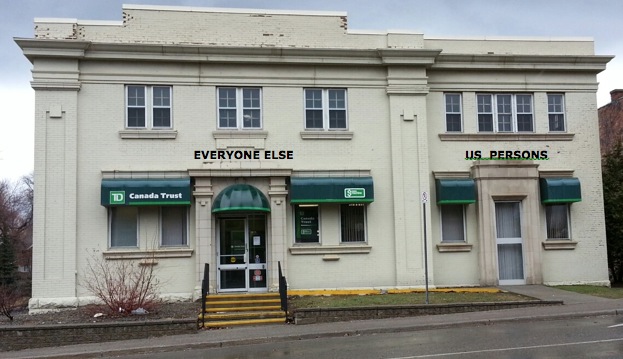
We need to know the actual questions and approaches and are focusing first on questions about U.S. personhood that will be asked by Canada’s major banks when Canadians open a NEW PERSONAL CHEQUING account after July 1. I suspect that different banks may ask different questions.
When you have this information, please provide in your comments these questions to be asked and I will update the top of this post.
[Please also read the disturbing comments below from @Pollyanna, who reports that one Canadian bank actually used information provided in casual conversations with the account manager to help establish whether the account holder is a U.S. person.]
My local Canadian bank branches provide this information on U.S. questions asked or not asked when opening a new account (this info may all be incorrect; please correct):
SCOTIA BANK: “Are you a U.S. person for tax purposes?”
http://www.scotiabank.com/ca/en/0,,6098,00.html
TD BANK CANADA TRUST: “Are you a U.S. citizen” AND “Where were you born?”
TD’s web information page: http://www.td.com/fatca/index.jsp
See: LM Correspondence with CustomerCare, TD for others to consider in relation to their own FFI’s web information and their relationship with their FIs.
HSBC CANADA: “Do you hold multiple citizenship” AND “What is your place of birth”
http://www.expat.hsbc.com/1/2/hsbc-expat/services/expat-tax/tax-matters/fatca?WT.ac=HBIB_14_5_29_home_small_pro_FATCA_Find_out_more
NEW HSBC information consent
CIBC: Local branch will receive info July 2.
Note: the link below is for CIBC World Markets, which deals with Wholesale Banking (Corporate & Institutional) as opposed to Retail Banking (Personal & Small Business). We have yet to see a CIBC FATCA page specifically written for Retail Banking clients. Perhaps as of July 2, once local CIBC branches receive info, there will be such as page on the CIBC website.
http://www.cibcwm.com/cibc-eportal-web/portal/wm?pageId=fatca&language=en_CA
BMO: “Do you have any other citizenships” (tentative per @Anne Boleyn)
http://www.bmo.com/home/about/banking/foreign-account-tax-compliance
RBC ROYAL BANK:
http://www.rbc.com/aboutus/fatca.html
I would be very skeptical of this information:
“If you open a new account and provide two pieces of ID that are not U.S. tainted and do NOT INCLUDE A CANADIAN PASSPORT (e.g., Canadian driver’s license and social insurance number are ok) and the bank has no other evidence to indicate that you are a US person (e.g., you never told the bank by mistake) no U.S. questions will be asked.
However, should you PRESENT A (TOXIC) CANADIAN PASSPORT at the time of opening an account, YOU WILL BE ASKED whether you do or do not have a U.S. place of birth.”
The way to stop the questions from being asked is to go to:
I was just speaking to a good friend on the phone this morning and he said a couple of things that made me go…aha!
What he said was this: one time a bank asked him to supply his SIN and he refused to give it. They said “but sir we are obligated to ask you for that information” and his response was “you may be obligated to ask me that question and now you have done so, so therefore you have met your obligation. However, that does not mean that I am obligated to answer the question.”
I suggest that in person, when asked questions we do not want to answer, we say things like that and on forms, we do what people do on contracts when they do not agree to a particular clause and cross it out, or put “NA”.
NEWS ON PRIVACY FROM SUPREME COURT JUST IN
Supreme Court bans warrantless cell phone searches, updates privacy laws
Major ruling updates privacy laws for 21st century
Read more: http://www.washingtontimes.com/news/2014/jun/25/supreme-court-bans-warrantless-cell-phone-searches/#ixzz35g09qwRr
@Pollyanna – Since the conversations you have had with the bank personnel over the years is pure hearsay and not in your files, I do not understand how they can possibly use that information. What if you were just making it all up? They have NO proof that you have ANYTHING to do with the US. You could sue them!
What is the Royal Bank of Canada approach to FATCA compliance?
I am very skeptical of the following answer, but after 45 minutes with a friendly customer service rep and her many phone calls to “Support”, this is what the Royal Bank of Canada told me:
If you open a new account and provide two pieces of ID that are not U.S. tainted and do NOT INCLUDE A CANADIAN PASSPORT (e.g., Canadian driver’s license and social insurance number are ok) and the bank has no other evidence to indicate that you are a US person (e.g., you never told the bank by mistake) no U.S. questions will be asked.
However, should you PRESENT A (TOXIC) CANADIAN PASSPORT at the time of opening an account, YOU WILL BE ASKED whether you do or do not have a U.S. place of birth. (I had her repeat this four times in different ways.)
Assuming that any of the above is correct, the customer service rep agreed with me that the wise course would be to not present a passport when opening the account. This really needs to be confirmed.
What was highly believable was what happens to you should you be identified to Royal Bank as a US Person: The Royal Bank “FATCA team” pays you a visit and presents you with a package.
GwEvil, interesting.
That, though, may not work for being deemed recalcitrant and then the bank automatically turning all your information over.
In plainer words, we would be (Synonyms for recalcitrant): disobedient, uncontrollable, fractious, obstinate, fractious, obstinate, rebellious, unruly, wayward, contrary — ETC. ending in willful.
@Stephen: I have no idea if that will or will not be RBC’s approach, but it is certainly one that makes sense.
In a cross-post I did of this thread at Maple Sandbox, I also posted the link bubblebustin provided here to the finalized CRA guidelines. While they are highly technical, they also show CRA is giving the banks huge wiggle room.
First, remember CRA information for individuals say banks are not required to ask for place of birth. If TD is doing that, they are doing it because they are choosing to do it, not because the IGA or the Act requires them to do it.
Secondly, the CRA guidelines for the FIs say a birth certificate with a city and state of birth, but no country if birth is not an unambiguous place of birth. I checked my birth certificate. It says Warren, Commonwealth of Pennsylvania. No country anywhere on it.
My passport, on the other hand, says place of birth Warren, USA with no state.
I think CRA intentionally is trying to give FIs a way of not identifying US persons among their customers. If what the RBC person told you is correct, they are taking the Don`t Ask. Don`t Tell approach with CRA`s blessing.
The other ones asking questions they are not required to ask could possibly give someone asked the questions a reason for a Human Rights or Privacy complaint. That is what I intend to do if TD or my new credit union asks me those questions.
If what the RBC person told you is correct, RBC will likely see an increase in business. TD and Scotia will likely lose business if the information provided about them is correct.
This is what CRA final guidelines say about unambiguous place of birth:
My BMO online query and answer:
To: Feedback
Subject: Questions for Opening a BMO Chequing and/or Savings Account
After July 1, 2014, what are the specific questions that BMO will ask of anyone opening a new BMO chequing or savings account?
BMO was the only one who figured out what I was really asking.
*****
RBC Royal Bank said:
CIBC replied:
@calgary411 – even if you were labelled recalcitrant, since you did not ADMIT to being a tainted US person, they couldn’t actually pin anything on you. Deny, Deny, Deny!!
Why in heavens name, presented with these kinds questions, would I not just lie? What’s the penalty for lying to your bank? The accuracy of this information doesn’t affect their ability to serve me in any other way, so I would choose to give them inaccurate information.
@PYYJ – I actually agree with you on that. There’s no bank jail, so yeah, why put yourself in harms way? What pisses me off, though, is why we should even be asked at all and I would love to tell them to piss off! I actually hope that Canadians who were born in sensitive countries such as Iraq, Iran, Egypt and Afghanistan amongst many others will take offense at being asked where they were born (not knowing it’s intent is to ferret out US tax cheaters like us) and raise a huge stink!
I opened an account for my daughter last week. As a minor she only needed her health card and SIN as verification of who she was. I could have used her birth certificate but they were fine with just the two I mentioned and I didn’t offer to bring in anything else.
The bank was ATB and we have banked with them long enough that they know perfectly well that we originate from down south. Yet I have not been asked to verify anything and I get the feeling that I won’t be any time soon.
Personally, I wonder if it is just banks who have a presence in the US that are going to be sticklers and I agree that the CRA (and the IGA itself to some extent) isn’t going to kill itself in the pursuit of human sacrifices. jmo.
What-if I am a naturalized US citizen living in Canada? In other words, I have 2 passports, one American and one Ukrainian. I use my American to enter the Canada, but I want to use my Ukrainian to open a bank account in Canada. That passport, obviously, shows non-US birthplace.
In that case, am I subject to FATCA? Can IRS or the bank find out?
Why do people here keep talking about bank accounts? Shhhheeeesh
get credit union accounts and stop talking about this.
The Canadian government cannot bother Egypt about the dual citizen reporter because to protest means they are hypocrites for not supporting US persons here
Anyone think about that conundrum?
My U.S. born mother (now deceased), sister and I have two BMO joint accounts which we just closed today as I am worried that my mother’s bank profile may include U.S. indicia When doing so, I discovered that all my accounts are linked to the joint accounts – ie, BMO mastercard & rsp mutual fund. When I asked for my bank profile, it still listed the two joint accounts, though indicated they were closed. Does anyone think that the bank’s “data mining” will still be able to uncover my mother’s U.S. indicia, in spite of the account being closed? If there’s any chance that U.S. indicia is still on my accounts, I will cancel my BMO mastercard and mutual fund.
Any and all thoughts are much appreciated 🙂
I may have missed this aspect, but it seems to me that none of the statements provided by the five banks indicated that only accounts OVER $50,000 would be reported to the CRA. I got the impression that if ANY U.S. indicia is discovered, the customer will be reported, regardless of the account balance. Did anyone else get this impression?
@ChearsBigEars
Of 5 replies that I’ve gotten from credit unions, 3 are reporting and 2 are non-reporting. All 5 of these only allow Canadian residents to hold accounts, so I was hoping 5 out of 5 would be non-reporting due to having a “local client base”. One probably _can_ assume that no banks are FATCA free, but you cannot assume all credit unions are safe.
@Sasha – the low hanging fruit will be the people with obvious US indicia and it probably won’t matter at all what their bank balances are. I’m betting that the banks may feel that they can score easy points with their masters at the Treasury dept by turning those people in.
@WhatAML
That’s not the point. Find a small one. I’m also thinking VANCITY is so anti Fatca that they ***might not even bother reporting voluntarily. Vancity is not like the rest. They don’t give a rats ass what the IRS wants or the CRA. No one can do anything to them as they are local and certainly are not part of the US war machine that those who bank in the major banks are contributing to. I sleep at night.
I understand that a rebellion is starting to take hold among certain credit union central and local credit union members who have had enough already and they are starting to see the bluff.
OMG !!! the USA is going to shut down the Canadian financial sector and ruin our economy and then let millions of central American kids in to make sure we all go broke. Who among us really believes that the USA is going to try to wreck our financial institutions? Really? Truly?
There is a requirement to search all accounts with balances over $50k and report. There is a bottom end, but no top end.
They can search and report everything. They can report as many positives of indicia as they want. The only requirement is the minimum. There is no requirement at the top end.
Just to be safe, they could and should just send the entire list of customers to the USA.
Mark Twain, see my small claims court post on another thread. I hope it got posted
Could the IBS website provide, as a shared resource, a country-by-country list of reporting and non-reporting institutions?
@chearsbigears
Re credit unions- looked like a good idea until I tried to find one here in quebec. The only choice here is the caisse populaire credit onion. It’s a monopoly. And they state that they will comply. Bad news for my sister, her kids who’ve never set foot in the states, and my 90 year old mother.
King of the Road: I think this is the list you want: https://www.abolishfatca.com/IRS_FFI_List.pdf
I was shocked to find my credit union listed here. According to its website it is impossible to open an account at this credit union if you don’t live in Canada. It shouldn’t have to have anything to do with FATCA or the IGA. The whole thing is an utter mess. No one knows the rules.
Would someone who is “safe” please contact Alterna Savings? I have been a “member” since 1977 and it appears to be on the list of compliant financial institutions. It is a CU that may have a significant number of academics at U of T (having been previously called the Universities and Colleges Credit Union) and as such may raise the interest of the many people in the academic world who should be paying more attention to this issue than they seem to be. So it appears that not only will I be an international second class citizen, I can also claim second class membership at an institution that I have given my business to for 47 years. Unbelievable.