
On July 2 2014 my understanding is that Canada’s banks will be asking (at least) new account holders questions and employing a variety of approaches to establish U.S. personhood. These questions will violate Canada’s Charter Of Rights and other laws. Many of us also wonder whether the Silent Majority out there feels that such questions have no consequence.
Coming to a Canadian bank near you?
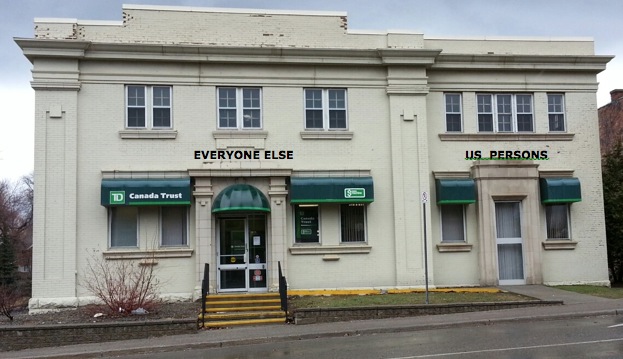
We need to know the actual questions and approaches and are focusing first on questions about U.S. personhood that will be asked by Canada’s major banks when Canadians open a NEW PERSONAL CHEQUING account after July 1. I suspect that different banks may ask different questions.
When you have this information, please provide in your comments these questions to be asked and I will update the top of this post.
[Please also read the disturbing comments below from @Pollyanna, who reports that one Canadian bank actually used information provided in casual conversations with the account manager to help establish whether the account holder is a U.S. person.]
My local Canadian bank branches provide this information on U.S. questions asked or not asked when opening a new account (this info may all be incorrect; please correct):
SCOTIA BANK: “Are you a U.S. person for tax purposes?”
http://www.scotiabank.com/ca/en/0,,6098,00.html
TD BANK CANADA TRUST: “Are you a U.S. citizen” AND “Where were you born?”
TD’s web information page: http://www.td.com/fatca/index.jsp
See: LM Correspondence with CustomerCare, TD for others to consider in relation to their own FFI’s web information and their relationship with their FIs.
HSBC CANADA: “Do you hold multiple citizenship” AND “What is your place of birth”
http://www.expat.hsbc.com/1/2/hsbc-expat/services/expat-tax/tax-matters/fatca?WT.ac=HBIB_14_5_29_home_small_pro_FATCA_Find_out_more
NEW HSBC information consent
CIBC: Local branch will receive info July 2.
Note: the link below is for CIBC World Markets, which deals with Wholesale Banking (Corporate & Institutional) as opposed to Retail Banking (Personal & Small Business). We have yet to see a CIBC FATCA page specifically written for Retail Banking clients. Perhaps as of July 2, once local CIBC branches receive info, there will be such as page on the CIBC website.
http://www.cibcwm.com/cibc-eportal-web/portal/wm?pageId=fatca&language=en_CA
BMO: “Do you have any other citizenships” (tentative per @Anne Boleyn)
http://www.bmo.com/home/about/banking/foreign-account-tax-compliance
RBC ROYAL BANK:
http://www.rbc.com/aboutus/fatca.html
I would be very skeptical of this information:
“If you open a new account and provide two pieces of ID that are not U.S. tainted and do NOT INCLUDE A CANADIAN PASSPORT (e.g., Canadian driver’s license and social insurance number are ok) and the bank has no other evidence to indicate that you are a US person (e.g., you never told the bank by mistake) no U.S. questions will be asked.
However, should you PRESENT A (TOXIC) CANADIAN PASSPORT at the time of opening an account, YOU WILL BE ASKED whether you do or do not have a U.S. place of birth.”
The way to stop the questions from being asked is to go to:
@Downtherabbithole
Sorry about the late reply to your post of July 20.
Bill C31 changes on of the paragraphs (Annex I 2.B.3), most of the references to the IGA on the web do not show the change. The original text was:
The new text is:
Paragraph B(4) is where they ask for a self-certification, a CLN or a reasonable explanation. So the review is now mandatory and the applications of the exceptions are now required. This is certainly better than my glimmer of hope comment earlier.
The legislation is still garbage, but at least we know that your information won’t be sent to the IRS because you bank decided to take the easy way out and report everybody.
@AnneFrank
Re this part of your comment:
There are no 2008 changes to the meaning of U.S. citizenship. The 2008 changes (actually 2004) are changes in the Internal Revenue Code that do NOT change the meaning of citizenship – but rather say that one is treated as being a citizen (even if one is not a citizen) until one settles up with the IRS. Put another way, the 2008 rules in the IRC are a way that the U.S. claims the right to tax those who are NOT U.S. citizens. This has no effect on whether one is or is not a U.S. citizen.
Therefore, questions about citizenship can reasonably answered in terms of the Immigration and Nationality definition of citizenship – meaning that anybody who has committed an expatriating act within the meaning of S. 349(a) of the Immigration and Nationality Act can answer that they are not a U.S. citizen.
Note that so much depends on the question asked:
“Are you a non-citizen who is treated as a U.S. citizen for tax purposes” is a different question from “Are you a U.S. citizen”. As you point out questions about birthplace are not determinative of anything anyway.
I just had a pleasant conversation with the manager at the local CIBC branch (small town Alberta). This mirrored a conversation I had with the new accounts manager at a CIBC branch in a nearby small town. At this time the only burning issue seems to be assuring that a new account holder is a local resident. They may also ask if you are a Canadian citizen. This would be for simple chequing or savings accounts. I suspect but did not confirm that their rules may be different for various investments.
While this manager was aware of the new FATCA IGA, I think the Draconian nature of FBAR penalties caught her by surprise. I think she was also unaware of, but not surprised by, the IRS non-privacy policy. So far no questionnaires are being mailed out. She also said that local branch managers are not informed of upcoming policy changes.
This is current information, of course all of this may change in time, especially next summer when the IRS starts trying to correlate FinCEN114s with FATCA bank reports.
On a more general note, I was able to determine that if you are transferring money from a US account to Canada, that writing personal cheques on the US account does not (yet) raise red flags, but electronic transfers certainly will. Keeping cheques under $10,000 can save needless paperwork.
@ehFreeman
Just curious, but why would an e-transfer be viewed more suspiciously than a cheque on a US account? Either one could indicate that you are a ‘Us person’ could it not?
I am also wondering, as this has never been clear to me although I suspect the answer is ‘no’, does the 30% withholding of US sourced funds (for example US cheques, e-transfers) apply to individuals who are deemed ‘US persons’ or recalcitrant ‘US persons’ or just to FFI’s who are not FATCA compliant?
@WhiteKat
I did not ask that specific question.
She did say that cheques were considered normal transactions and not as easily traced as wire transfers. The cheque transfers I have made have not flagged my account. She also said that large cash deposits were viewed with suspicion. Incidentally I got identical advice from my US account manager.
This came up because I am moving money from my US account to Canada. I am no longer an American so I really do not want to see this Canadian account listed in an IRS database.
I have closed or will close in the near future those accounts I was forced to list on previous F(u)BARs/FinCENs. Essentially I am changing the locks on the doors. Far too many people have access to those IRS databases. I think I read somewhere that around 11 million IRS refund cheques went astray last year so imagine how much worse it could be when the IRS shares the database with all comers.
LM would like to share here a pdf of correspondence ‘from’ and ‘to’ CustomerCare, TD…
for others to consider in relation to their own FFI’s web information and their relationship with their FIs. (This is TD’s: http://www.td.com/fatca/index.jsp.)
@calgary411
I don’t see any mention of the $50,000 threshold.
Also, it’s not clear to me if they will question everyone, or only people who have US indicia according to an electronic search. Did I miss it? Do you have any idea?
Hang Seng Bank in Hong Kong has been sending out notices to accountholders about amendments to the customer agreement starting from 1 October. Doesn’t mention the word FATCA but I’m told that’s clearly what it’s aiming for. Trying to get my hands on a copy or find one on the internet.
(Weird because I thought they would have qualified as a local client base institution, though maybe not because they’re majority owned by the drug-money-launderers over at HSBC.)
WhatAmI,
No, I don’t see anything about the $50,000 (aggregate?) threshold. It should be determined if that is a factor in TD’s “search” or will they look for US indicia generally instead of if accounts with them total $50,000 or more.
LM,
In your communications with CustomerCare, TD can you please ask for clarification on this / confirmation they will not use the $50,000 threshold before searching client records for US indicia?
@Calgary411 & WhatAmI:
I will send a note about the $50,000 (aggretate) issues you raise and let you know. However, (1) it is the weekend so nothing will be dealt with until next week anyway and (2) last time I wrote to them it took several weeks to get a reply (probably because Customer Care had to go back (to the PR folks who wrote up the TD-FATCA page initially) with my all-too-many questions/comments (which, on first attempt, they tried to brush off with a very glib kiss-off reply saying I was not to worry, that TD had my best interests in mind, lada-lada-lada). Don’t we all just love being “kissed off”?????????
@LM, thank you for your thorough critique of the TD information, and for sharing the letter you wrote to them as well as their unsubstantive unsatisfactory and evasive reply. Heads up to others as to what they can anticipate from TD, and from the other CBAnksters.
Dittos to what Anne Frank wrote….
1.) To those that relinquished with or without a CLN.
2.) Those that did not relinquish but have citizenship of and live in a country that signed “Convention on Certain Questions relating to the Conflict of Nationality Laws”
3.) Others are likely hard pressed.
4.) But this does not make the matter right at all…..
“I continue to be of the view that FATCA or no FATCA, current Canadians who can reasonably say that they became Canadian expecting/intending/accepting loss of US nationality should be able to stay out of the FATCA mess providing they have kept and continue to keep their birthplace and past history to themselves.”
and
“I don’t think it anyone’s business in Canada to be sure, but I think we can expect that any bank that goes past self-certification to try to form its OWN view on US tax status will find itself on very thin ice if push-back is received on privacy or HR grounds. The law does not OBLIGE them to do so and being eager-beaver auxiliaries to a modern-day Spanish Inquisition is not going to be where they want to be found once the courts start to get their teeth into this.”
More of a general question here.
My impression is that what the FATCA IGA is intended to accomplish is to do an end around Canadian banking and privacy laws.
Am I correct that it in no way alleviates the 30% withholding threat that the IRS is using to bludgeon these institutions into complying with FATCA requirements?
To All – When reading the letter that I wrote to TD, the comments I made there will make more sense if you are (at the same time) reading/looking over what TD has listed as their “answer” to their listed set of questions. See: http://www.td.com/fatca/index.jsp
ehFreeman,
The IGA is what protects the banks from the 30% withholding, as well as allowing them to comply with FATCA without breaking any privacy or discrimination laws. Take away the IGA, and banks would have to choose between being FATCA compliant on an individual basis (thus breaking Canadian laws) or refuse to comply and suffer the 30% withholding.
This is why banks pressured the Canadian government so hard for the IGA. They wanted to be able to comply with FATCA without breaking Canadian law.
@WhiteKat
I really am not sure of the answer, but it seems to me that if the IGA somehow protects the banks from the threat of that 30% withholding on US sourced income, there is no way they would even go to the pretense of attempting to comply with FATCA.
My best guess is that the IGA only relieves them of the consequences of violating Canadian banking and privacy laws as they scramble to comply with FATCA.
@ehFreeman:
The banks remain under threat – – the IGA just gives them some time to get organized and up-running with FATCA requirements.
The IGA will not protect the banks (or other Canadian FFIs) if they fail to demonstrate that they are making a good-faith attempt to comply with FATCA. If, a year or two from now, the IRS believes that a specific FFI in Canada is NOT complying with the agreed FATCA requirements, the 30% “punishment” might start to be instituted for that FFI. As well, likely, Canada might get a general stern warning about it’s not being trustworthy in making sure all FFIs do as they were told.
ehFreeman.
Yes, banks still have to comply with FATCA under the IGA. The IGA makes it legal from a Canadian standpoint for them to do this. IGA, or no IGA, the banks risk 30% withholding if they do not comply with FATCA
@ LM
That’s how I see it too. Thanks. This is a message we have to get out to Canadians.
The FATCA IGA just gives the IRS a Canadian approved hammer to be used in the future whenever an FI is deemed not compliant enough (or more likely when it is deemed to be a bit too competitive for US FIs).
Interestingly I noticed that there is a significant difference between Scotiabank’s investment account application form versus BMO’s:
http://www.scotiabank.com/itrade/en/files/12/04/etca_NCAF_8980012_%280511%29.pdf
https://www.bmoinvestorline.com/selfDirected/pdfs/PersonalAccountApplication.pdf
The BMO form notes that “US persons” will need to fill out a W-9, but it doesn’t attempt to define the rather vague “US person” concept so presumably someone who does not consider themselves a US person would just ignore this.
OTOH the Scotiabank form defines “US persons” to be “US citizens (including persons with dual citizenship), US resident aliens, persons born in the USA, US lawful permanent residents (e.g. Green Card Holders), …, or persons who meet the Substantial Presence Test for U.S. Residency”. This makes it much harder for someone born in the USA to truthfully deny a connection w/the US. Specifically singling out “persons born in the USA” seems especially offensive (as opposed to just including them under the more general category of US citizens).
For some reason the “.pdf” at the end of the Scotiabank link didn’t get included in the hyperlink so you need to cut and paste it manually–including the .pdf at the end–into your browser.
Should work now
and here is another from Scotiabank: https://www.wmprofile.scotiabank.com/oam/jsp/index.jsp
If I answer “no” when asked by my bank if I am a “US citizen with dual citizenship”, what are the possible consequences of being untruthful?
@Sasha – I think the bank cops throw you in bank jail 😉
Seriously, I really don’t see how they’d ever be able to discern that you were in fact a tainted person unless you admitted it somehow. I mean are they going to hook us up to polygraph machines?
@GwEvil
Thanks for the chuckle 🙂 . . . and common sense thinking . . . probably just my paranoia taking over.