
On July 2 2014 my understanding is that Canada’s banks will be asking (at least) new account holders questions and employing a variety of approaches to establish U.S. personhood. These questions will violate Canada’s Charter Of Rights and other laws. Many of us also wonder whether the Silent Majority out there feels that such questions have no consequence.
Coming to a Canadian bank near you?
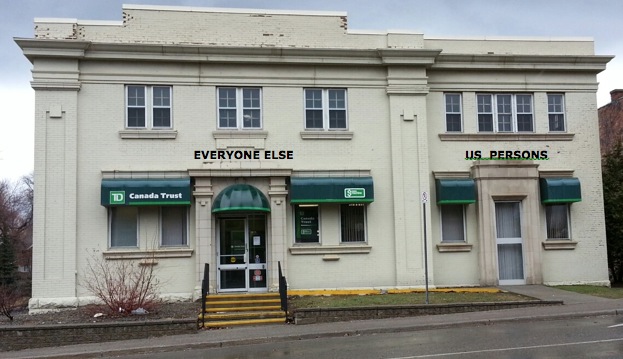
We need to know the actual questions and approaches and are focusing first on questions about U.S. personhood that will be asked by Canada’s major banks when Canadians open a NEW PERSONAL CHEQUING account after July 1. I suspect that different banks may ask different questions.
When you have this information, please provide in your comments these questions to be asked and I will update the top of this post.
[Please also read the disturbing comments below from @Pollyanna, who reports that one Canadian bank actually used information provided in casual conversations with the account manager to help establish whether the account holder is a U.S. person.]
My local Canadian bank branches provide this information on U.S. questions asked or not asked when opening a new account (this info may all be incorrect; please correct):
SCOTIA BANK: “Are you a U.S. person for tax purposes?”
http://www.scotiabank.com/ca/en/0,,6098,00.html
TD BANK CANADA TRUST: “Are you a U.S. citizen” AND “Where were you born?”
TD’s web information page: http://www.td.com/fatca/index.jsp
See: LM Correspondence with CustomerCare, TD for others to consider in relation to their own FFI’s web information and their relationship with their FIs.
HSBC CANADA: “Do you hold multiple citizenship” AND “What is your place of birth”
http://www.expat.hsbc.com/1/2/hsbc-expat/services/expat-tax/tax-matters/fatca?WT.ac=HBIB_14_5_29_home_small_pro_FATCA_Find_out_more
NEW HSBC information consent
CIBC: Local branch will receive info July 2.
Note: the link below is for CIBC World Markets, which deals with Wholesale Banking (Corporate & Institutional) as opposed to Retail Banking (Personal & Small Business). We have yet to see a CIBC FATCA page specifically written for Retail Banking clients. Perhaps as of July 2, once local CIBC branches receive info, there will be such as page on the CIBC website.
http://www.cibcwm.com/cibc-eportal-web/portal/wm?pageId=fatca&language=en_CA
BMO: “Do you have any other citizenships” (tentative per @Anne Boleyn)
http://www.bmo.com/home/about/banking/foreign-account-tax-compliance
RBC ROYAL BANK:
http://www.rbc.com/aboutus/fatca.html
I would be very skeptical of this information:
“If you open a new account and provide two pieces of ID that are not U.S. tainted and do NOT INCLUDE A CANADIAN PASSPORT (e.g., Canadian driver’s license and social insurance number are ok) and the bank has no other evidence to indicate that you are a US person (e.g., you never told the bank by mistake) no U.S. questions will be asked.
However, should you PRESENT A (TOXIC) CANADIAN PASSPORT at the time of opening an account, YOU WILL BE ASKED whether you do or do not have a U.S. place of birth.”
The way to stop the questions from being asked is to go to:
For Canadian physicians who invest with MD Management (financial firm associated with the Canadian Medical Association). MD Management’s position is they will feed their clients to the IRS.
https://mdm.ca/about-md/news-and-publications/news/2014/tax-changes-us-persons.asp
Yikes Doc. I think this is the first time we have seen this question:
“Were you born to a parent who is a U.S. citizen?“
OMG!!! How many doctors are ‘US persons’ in Canada??? We need to reach out to them about this!! They have a huge lobby group and perhaps this will get some momentum going in that quarter.
That question about where the parents were born is absolutely chilling!!!
CMA wrote to Flaherty about this over two years ago. The question now is how do we reach those directly affected?
https://isaacbrocksociety.ca/2012/04/23/canadian-medical-association-position-on-fatca-and-fbarmust-read/
Great find, BC Doc!
From the MD Physician Services website:
What other services to meet ‘total wealth management needs’ might there be for other categories of professionals?
My doctor’s a US citizen. I’ve reached out to her, but I think she’s ostriching. Perhaps not any more after this bulletin. Yikes, US citizenship by descent mentioned!
That is the first time the parentage question has come up. Anyone that doubted the invasive nature of this witch hunt and the extremes to which it would go now has their answer.
It is now a priority to begin educating the kids on the importance of renouncing US citizenship otherwise their lives will be tarnished indefinitely.
They didn’t even get the question right. It should be “Were you born to a parent who was a U.S. citizen at the time of your birth”
Let’s not tell them 🙂
@ Hogwarts, yes the kids need to be educated about renouncing.
Passing on citizenship to your children is a little more complicated than the answer to the question “Where you born to a US citizen?” Are all the financial institutions going to become US citizenship experts or will they just send everyone’s information to the CRA for forwarding to the IRS if the answer to this question is “yes”? My children have no US taint but are technically born to a US citizen (by the US definition, not mine). This question seemed to be in a list of possible considerations, hopefully it will never appear on an actual document to sign. Regardless our children need to know to be careful about sharing this information.
Services offered from the MD Management website:
Wealth Management: Built on the principles of strong performance and prudent risk management
Investments
•Investment Accounts
•MD Precision PortfoliosTM
•MD Funds
•Income Solutions
•MD Private Investment Counsel
Estate and Trust
•Estate Planning
•Trust Planning
•Estate Settlement
Banking
•Personal Banking
•Business Banking
Incorporation
•Benefits and Opportunities of Physician Incorporation
•Wealth Management Strategies
•Estate Planning for Incorporated Physicians
Insurance
•Wealth Optimization and Permanent Life Insurance
•Protect your Practice
•Lifestyle Protection
I stopped using the services of MD Management many years ago (I think their funds are overpriced– i.e. high MER) therefore I can’t say how actively their advisers are looking for US taint among their clients. If I was still with them, that press release would represent the kiss of death. I wouldn’t be able to get out the door quickly enough.
That letter from MD management seems quite stern. I wonder if there’s any familiar names on their list of “independent legal and tax experts” who might also be advising them.
@BC Doc, if I was a long time client of theirs and that letter was my first introduction to the world of US taxation, I’d probably have a heart attack. Sounds as though they’d be happy to see the back side of you even though you may have invested with them for years (which by the sounds of it, they profited heavily from). Someone has scared the crap out of them, for them to even mention that a client could be a US citizen through a parent – and now they’d rather not deal with you. These people give me the creeps, but we should expect more of this kind of treatment as more FI’s and investment firms have their OMG moments.
Well, here’s a subtle clue might pick up, especially if you use the drive-up window:
http://non-fatca-banks.com/images/usa.jpg
@Moderators, the find by our friend BC Doc needs front page attention.
Canadian FI asks, “Were you born to a parent who is a U.S. citizen?”
@Brockers, on this side of water I personaly know young people at University who were outed because they presented a long form birth certificate as a second form of identification. These are students who have never been to the states, never had a US Passport and failed to register for selective service.
I would like to make a few points about the MD Management issue.
Nowhere does it say that MD Management will be asking any of these questions. The list of questions a simple definition of US Person and if any of them apply to you talk to a lawyer.
Its written as an alarmist warning to doctors who as a group are very likely to meet the reporting thresholds and need to be aware of the situation.
They specifically state that they “Employees (…) are not permitted to make any determination of a client’s U.S. status (…)”. I doubt very much that any question other that the generic “Are you a US person?” will be asked.
@Just a Canadian:
The physicians should announce and warn USA residents that in the event of a major disaster (e.g. Hurricane Katrina, Gulf Coast 2005) some Canada physicians will not travel to U.S.A. to provide medical help because they might get nabbed at the port of entry.
Even if you think you are under the radar, consider how somebody greedy could betray you:
http://www.irs.gov/irb/2014-36_IRB/ar08.html
Be all the more careful to know the geography wherever you go, lest somebody trick you into entering U.S.A.
Long story short. MD management knows, because we didn’t want to lie when asked the question about place of birth. I asked about the timeline to reporting and what we could do to avoid that. Since we are NOT US persons, due to prior relinquishment, but we do not have the CLN. Here is the response I got.
I heard back from our Compliance Department on this issue and was advised of the following:
– No sharing of information with CRA has yet begun (the first reporting date being 02 May 2015).
– Reporting to CRA in 2015 can be avoided if we have acceptable documentation on file prior to 2014 year-end indicating why a client is not to be considered a U.S. citizen. Here is some information on this point, including the type of information we will have to share with CRA (this wording is apparently taken straight out of the Canadian Inter-Governmental Agreement with the U.S.:
When the indicium found is an unambiguous indication of a U.S. place of birth, the account must be reported unless the financial institution obtains or currently maintains a record of all of the following:
1. a self-certification showing that the account holder is neither a U.S. resident nor a U.S. citizen;
2. evidence of the account holder’s citizenship in a country other than the U.S. (for example, a passport or other government-issued identification);
3. and a copy of the account holder’s Certificate of Loss of Nationality of the United States or a reasonable explanation of why:
• the account holder does not have such a certificate; or
• the account holder did not obtain U.S. citizenship at birth.
Information to be shared for the 2014 tax year (reported May 2, 2015) is:
1. Name
2. Address (home residence)
3. U.S. TIN (Tax Identification Number) i.e. SSN (if no US TIN on file then date of birth is required)
4. Canadian TIN (Tax Identification Number) i.e. SIN
5. Account number
6. Account balance or value
I
Further to the above post. We have made a plan to get a self certification drawn up ASAP and present that to our advisor together with our “reasonable cause”: obfuscation on the part of the embassy when we visited in September and inability to get an appointment until well into 2015, as well as the fact that the relinquishing act dates back to 1999 when we were not required to bring it to the attention of US authorities or obtain a CLN. If they don’t like that we will take our money elsewhere. But who will have us? That is the question.
@SilverBirch, as indicated on these boards elsewhere you should have a sworn affadavit under Canadian Law properly witnessed/notarised by a lawyer/notary.
You will need to state what you did, when you did it, how that was expatriating under US Law quoting the law section by section and a final statement that you are not a US Citizen.
Again, a CLN would always be considered the best document. But the truth of the matter was prior to July 2014 a CLN was frankly not needed under Canadian Law!!!
It is unfortunate that past relinquishers have to go to great lengths to document past relinquishments.
Your papers please!
@george Thanks for all your help on this. I think it was you, though it may have been, duke of Devon, WhatAmI, or BCDoc, but I thought someone had something to say about what questions they should not be asking. Just wondering if this was something written into FATCA? Were they not supposed to ask where you were born? In our case, it would have been possible to answer no to any number of questions, just not the one they chose to ask. Are you a USC? NO! Do you have a US passport? NO! Do you have any ties to the US? NO! List your held citizenships. ONLY Canadian! I do find it astounding that our government is colluding in this violation of privacy laws and outright discrimination.
The CRA FAQ on FATCA says FIs are “not required” to ask if a client was born in the US, but it does not say they cannot ask the question. The next point says the FI is legally entitled to ask for information to “know where you reside for tax purposes”, but doesn’t spell out the questions. It seems everywhere you look it says what a FI can or must do, but never what it must not.
http://www.cra-arc.gc.ca/tx/nnrsdnts/nhncdrprtng/fq-eng.html#q2-6
@ WhatAmI Thank you. I will forward this link to MD management and suggest they may want to be more careful in their line of questioning. They could do the minimal due diligence without uncovering many of us who don’t consider ourselves US citizens, as long as they don’t ask the place of birth question. Too late for us unfortunately, but maybe they will change the form before too many accidental Americans get caught.
@Silver Birch, I opened an account post July in the EU. The form had Place of Birth. I told the person point blank that was a discriminatory question. They quickly said that was optional and I only needed to answer my citizenship which I did.