
On July 2 2014 my understanding is that Canada’s banks will be asking (at least) new account holders questions and employing a variety of approaches to establish U.S. personhood. These questions will violate Canada’s Charter Of Rights and other laws. Many of us also wonder whether the Silent Majority out there feels that such questions have no consequence.
Coming to a Canadian bank near you?
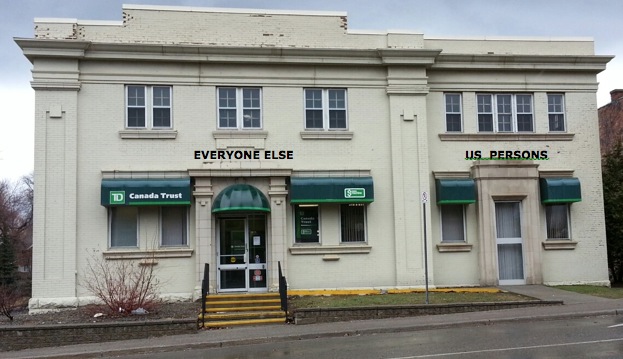
We need to know the actual questions and approaches and are focusing first on questions about U.S. personhood that will be asked by Canada’s major banks when Canadians open a NEW PERSONAL CHEQUING account after July 1. I suspect that different banks may ask different questions.
When you have this information, please provide in your comments these questions to be asked and I will update the top of this post.
[Please also read the disturbing comments below from @Pollyanna, who reports that one Canadian bank actually used information provided in casual conversations with the account manager to help establish whether the account holder is a U.S. person.]
My local Canadian bank branches provide this information on U.S. questions asked or not asked when opening a new account (this info may all be incorrect; please correct):
SCOTIA BANK: “Are you a U.S. person for tax purposes?”
http://www.scotiabank.com/ca/en/0,,6098,00.html
TD BANK CANADA TRUST: “Are you a U.S. citizen” AND “Where were you born?”
TD’s web information page: http://www.td.com/fatca/index.jsp
See: LM Correspondence with CustomerCare, TD for others to consider in relation to their own FFI’s web information and their relationship with their FIs.
HSBC CANADA: “Do you hold multiple citizenship” AND “What is your place of birth”
http://www.expat.hsbc.com/1/2/hsbc-expat/services/expat-tax/tax-matters/fatca?WT.ac=HBIB_14_5_29_home_small_pro_FATCA_Find_out_more
NEW HSBC information consent
CIBC: Local branch will receive info July 2.
Note: the link below is for CIBC World Markets, which deals with Wholesale Banking (Corporate & Institutional) as opposed to Retail Banking (Personal & Small Business). We have yet to see a CIBC FATCA page specifically written for Retail Banking clients. Perhaps as of July 2, once local CIBC branches receive info, there will be such as page on the CIBC website.
http://www.cibcwm.com/cibc-eportal-web/portal/wm?pageId=fatca&language=en_CA
BMO: “Do you have any other citizenships” (tentative per @Anne Boleyn)
http://www.bmo.com/home/about/banking/foreign-account-tax-compliance
RBC ROYAL BANK:
http://www.rbc.com/aboutus/fatca.html
I would be very skeptical of this information:
“If you open a new account and provide two pieces of ID that are not U.S. tainted and do NOT INCLUDE A CANADIAN PASSPORT (e.g., Canadian driver’s license and social insurance number are ok) and the bank has no other evidence to indicate that you are a US person (e.g., you never told the bank by mistake) no U.S. questions will be asked.
However, should you PRESENT A (TOXIC) CANADIAN PASSPORT at the time of opening an account, YOU WILL BE ASKED whether you do or do not have a U.S. place of birth.”
The way to stop the questions from being asked is to go to:
Please provide the questions the big Canadian banks will be asking new account holders on July 2 and I will update the post.
Stephen, shouldn’t anybody getting questioned about _existing_ accounts report that here as well?
Carol from Calgary
Jun 22, 2014 at 08:34 PM EST
Ane-Isabel M from London
Jun 22, 2014 at 10:18 PM EST
I then sent this to TD portfolio manager (so different than TD Bank):
***************
Reply:
*****************
From me:
**************
Ending in:
Great idea documenting the inquisitors.
@ Calgary411 –
Well, you got a better answer than I did from TD. Just over a week ago I wrote to their Customerservice@TD making numerous comments about their FATCA document (http://www.td.com/fatca/index.jsp). Perhaps I overwhelmed them but I wanted to add my 27 cents about how their webpage was misinforming clients through pat simplistic statements, subtle avoidance of important details, and a tenor of PR for the IRS/IGA rather than demonstrating/expressing any understanding empathy for those customers who will be effected.
In relation to one question (#20 in their FAQ) I wrote:
“It states “TD will only accept original documentation”. However, just above, TD indicates that if there are multiple requests for FATCA information that each request must be completed (separately). How can one provide several “original documents” if they have more than one account with TD and have to complete multiple forms? If one has accounts with another firm, they too may want “originals”. This is an untenable expectation. Further, if one has a Certificate of Loss of Nationality, this is a vital legal document for the individual to hold on to for many purposes in the future; how can one provide it to TD if it is needed, for example, to cross the border to visit one’s dying great aunt in the US?”
TD Customer service’s response was a pat-on-the-head statement which made no reference to any of the issues I raised (admittedly lots of issues):
Hello There, Thanks for contacting us today. I’m happy to confirm the following for you:
-TD is committed to complying with all applicable laws and regulations in the jurisdictions where we operate.
-TD, along with all Canadian financial institutions, is required to comply with the Canadian law.
-TD is committed to providing our customers and clients who are affected with relevant information to ensure they are informed once the law comes into effect on July 1, 2014.
-We have an FAQ available on our public website, which can be found at the following link: http://www.td.com/FATCA/index.jsp
Enjoy the rest of your day.
Regards,
Andrea
Internet Correspondence Representative
I emailed back that their response was rather condescending and a dismissive brush-off which did not address my concerns. I further asked that my comments be forwarded to someone more senior in TD-CT that would actually read and take into consideration my questions and comments.
I have not heard back again from TD Customer Service but, hey, it was only last week. I suspect that they (and all the banks) are going to be absolutely deluged with questions (do we feel sorry for them?????) and, like the IRS, totally overwhelmed with detailed sometimes obscure inquiries that they will have to deal with. The level of customer anger and angst will rise……. Their local staff seem to know nothing of the remarkable breadth and complexity of this issue and what it will mean for the local customers with whom they have relationships.
We have accounts with RBC-Dominion. Renounced-hubby and renounced-me have had lengthy conversations with our rather senior advisor there who certainly understands the issues. However, he has had no information or directives from the RBC FATCA-team. So, I guess everyone is waiting for July 2. Aren’t we lucky to have this “period of calm” in our lives………. 🙁
Interesting that the FATCA FAQ is only on the “TD Bank Financial Group’s corporate site” td.com, not on the “Canadian personal and small business financial services” site, tdcanadatrust.com.
I recently opened up two savings accounts for a minor child, one at a local credit union and one at RBC. I showed my son’s SIN card and Canadian Citizenship card, and nobody asked for his place of birth. I coached my child to not answer if someone asked where he was born. I told him not to lie, but to be shy (which he is naturally, anyway).
“Why should I be shy, Mummy?”
“Alas, the Canadian government just passed a law that makes you a second-class citizen, and I am trying to get a bank account sorted for you so that you have a long-standing history by the time you are a working adult.”
No questions about place of birth were asked, but one woman said RBC preferrs a birth certificate. I just shrugged my shoulders and said that I had misplaced it. I was ready to make a big fuss about discriminatory questions, but no fuss was needed.
This madness is getting out hand! We are now getting the Swiss treatment. The way to combat this insanity is to give to the Legal Challenge! We must stop them in their tracks!
I opened an account (new client) at BMO on June 12, and was asked by the financial manager whether I was a Canadian citizen, to which I answered yes…next question, do you have any other citizenships? Answer: I was born in Great Britain so I am a British citizen. Next question: do you have any other citizenships? Since I needed to open this account, and I am 100% compliant with US tax, FBAR and FATCA, (albeit six figures lighter in the pocket due to FBAR fines and legal/accounting fees in the 2009 so called amnesty), I answered that I became a naturalized US citizen just prior to marrying my Canadian husband 26 years ago and coming to Canada to live permanently. I then asked him if this (US citizenship) posed a problem and he answered “Oh well, we will just call you Canadian then” Of course I don’t know what he entered on his computer. Ipsos has called a couple of times when I was not available, but I plan to tell them this story and object vehemently to being questioned about my citizenship, Canadian or otherwise, thus making me feel like a second class Canadian. Although this line of questioning would ferret out all immigrants/naturalized Canadians.
Warning! Within a week of each other, both our RBC personal/business account manager and our RBC Dominion Securities advisor informed us they are required to report our jointly held accounts (me: Canadian and US citizenship, husband: Canadian only) even if nothing in their paperwork currently identifies me as American. Just the fact that they became aware of it in conversation, over the course of our years long relationships with them, compels that the information be passed on. I appreciated their honesty, and am in the final stages of our divorce with their services.
@Pollyanna – holy CRAP!!! Grrrrr!!
@Pollyanna
That’s bad news. The IGA says they only have to report due to personal knowledge if the accounts are over $1 million. I won’t ask if yours is over the threshold. Many people have been guessing all along that the banks will ignore all the thresholds and report everything and everybody regardless.
@Anne Boleyn,
Thanks for the info on BMO. I have incorporated the question put to you by the bank in the post above. All bank questions in the post are “tentative” but are likely close to what we will be asked after July 1.
@What Ami,
Yes, I would also like to know what happens to existing accounts, but I suspect that the answer at present will not be straightforward. If others can find the answer for the existing accounts, add a comment and I will also put this in the post. (See Pollyanna below)
@Pollyanna,
To clarify, are you saying that Royal Bank ferreted out your existing personal account, not by a computer search, or by any written statement you made to the bank, or by asking you in person or in a letter whether you are a U.S. person as part of a search, but did so because of information you happened to provide in (private) conversations with the account manager?
We need all this info on new and existing accounts to detail how our rights are being violated.
http://www.adcs-adsc.ca
My investment guy said he’d have to report my RESP and TFSA in three yrs (when they updated their forms) and disagreed with me when I said those were exempt from reporting (although not exempt from taxation by the IRS). I had to get Tricia to send me the relevant statutes in the IGA stating that they are exempt from reporting, so I could pass them along to straighten him out. This guy is a friend of the family, so imagine what wrong knowledge in the hands of people who don’t care about you will do! This is going to cause rifts in banking/investment relationships, friendships and marriages! Just untold harm! I know I probably sound like a broken record, but I can’t emphasize enough that we need people to spread the word far and wide and keep donations coming in. We cannot afford to lose this fight!
Stephen, I agree:
One way or another (and in a similar way as Pollyanna), my rights will be violated because I came out with my name and have been vocal in both Canadian and U.S. media about my son’s “entrapment into *supposed* US citizenship by mental incapacity”. Let’s see: choice of my right to free speech (my speaking out to try to get some traction in the media on the audacity of what is happening to people) and hiding in a corner (not to be noticed) to protect my family, especially my son (who realizes nothing of this). I have actually been admonished by a person who described himself as a former DOS consular person / lawyer commenter for not doing so.
Of course, I have no one to blame but myself for the consequences of my hard decision to speak out for my son and other vulnerable persons like him. Look for the next chapter to my story in a newspaper near you when / if the bank at which I hold my son’s Canadian Registered Disability Savings Plan (not the one referred to above) comes asking.
You are so correct, GwEvil. Mistakes like you just described will happen right and left.
In one of my comments to Patrick Cain’s Global News article, I said something similar:
Our voices = Our donations to http://www.adcs-adsc.ca/.
I am so glad that we opened up accounts at a credit union a while back. There will be a big exodus from the mainstream banks soon and I, for one, am glad! They deserve all the client loss possible for being such traitors. We won’t be renewing our mortgage with them either.
Are credit unions not asking such questions?
@Maryanne – technically speaking they are supposed to be exempt from FATCA reporting if they are under $175 million in assets and/or resident only accounts (no one is sure if it’s one of those, or both of those). Some seem to be asking “the question” even though they are exempt but some seem completely unaware of FATCA. my bets are on credit unions for the foreseeable future. I opened a couple of CU accounts as insurance. Once my mortgage is up, I will be out of the banks.
Pollyanna, your story is the fulfillment of my blog post February 10, 2014. I didn’t think it would happen this fast: https://isaacbrocksociety.ca/2014/02/10/the-potential-hazard-of-the-over-zealous-bank-inquisitor/
Just to clarify, an FI with total assets under $175 million is “deemed compliant:. An FI with assets over
$ 175 million with a local client base of 98% or more by value, would still be subject to FATCA, but would be considered a Non Reporting Canadian Financial Institution. An NRCFI would register with the IRS and must demonstrate ( I presume to CRA) that they have an ongoing system for monitoring their accounts for the 98 % threshold.So even those FIs have a FATCA related cost, but would not have to send account information to CRA
As an aside, prior to deciding to obtaining a CLN, I opened up several new brokerage and bank accounts at a time when I was sure very few would know anything about FATCA. I hope I don’t end up like W. C Fields who according to legend:
“W.C. Fields had such a terror of being caught broke that whenever he visited a city for the first time, he hurried to open a bank account. Unhappily he often failed to keep a record of the bank’s name, the pseudonym he chose for himself, and the amount of the deposit; but it has been estimated that there were some 700 of these accounts, totaling more than $1 million. The twenty-three pseudonyms that survive include Aristotle Hoop, Sneed Hearn, Cholmondeley Frampton-Blythe and Figley E. Whitesides.”
In one of the links listed on a new thread here I read on an IRS page that in the year 2015 “gross income will be put into an interim holding account”
Did anybody else catch that?
Most CUs are not availing themselves of the full LCB exemption unless asset bases are under a small threshold. Some have already reported to CRA without prior notification. Likely follow the bank guidelines in terms of dollar thresholds.
Stephen-
When I click on the ADCS link in the post, i.e., in
The way to stop the questions from being asked is to go to:
http://www.adcs-adsc.ca
and also in the ADCS link in your June 23 10:40 pm comment above, I get the message:
“Oops! That page cannot be found.” Please check these links.
between the pipes: Could you clarify what you mean by, “Some [credit unions] have already reported to CRA without prior notification.”? Could you identify which credit unions and what have they sent to CRA already? It’s not even July 1 yet.