

There are different legal remedies that can be taken under UK law to attempt to block this agreement. However, there are not really any commentators here from the UK so I have not really spent much time explaining them. If anyone is interested in the UK I can provide more detailed advice if necessary.
http://www.hm-treasury.gov.uk/press_82_12.htm
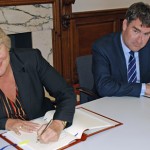
The two individuals pictured are Emily McMahon of the US Treasury and Deputy Exchequer David Guake. One piece of news is that UK Credit Unions will be exempt from FATCA even if they have UK Resident US Person account holders. Again if their are individuals willing to fight FATCA in the UK I can provide assistance and advice however, no one appears to want to do so.
@Tim
Thank you for identifying these “US persons” in Canada.
Strictly speaking, I don’t think we know whether these individuals have been IRS compliant, though someone who came here age two and has not otherwise lived in the US presumably has not been compliant. I believe I read that David Alward entered one version of the OVDI.
Again, thanks.
*I know Diane Ablonczy isn’t compliant and is not going to become compliant because she doesn’t believe she is a US citizen and doesn’t have a US Passport however, she doesn’t have a CLN either from what I understand.
Another is Mike Sullivan, MP, York South-Weston. My “conversation” with him is herein the early Isaac Brock Society days: https://isaacbrocksociety.ca/2012/01/31/appreciated-conversation-with-honourable-mike-sullivan-ndp-fellow-us-person-in-canada-reasonable-cause-certificates-of-loss-of-nationality-etc/
I’ve heard from a reliable source that there is at least one provincial supreme court judge in OVDI.
From a quick reading I’m not clear if exempt accounts such as retirement accounts will be aggregated with non exempt accounts for threshold level determinations.
Also from a quick reading, it appears that the burden is almost entirely on the UK. What kind of a deal is this?
The story has now been covered by The Financial Times:
http://www.ft.com/intl/cms/s/0/27757d4c-000b-11e2-a30e-00144feabdc0.html#axzz26gCoHDy4
Question on the UK FATCA Agreement date – likely to be an equally applicable question on a potential Canada FATCA Agreement, especially if one is signed in the next few months – what is the date of effectiveness of the UK FATCA Agreement, is it the date of the signing (12 September 2012), or is it the “in force” date per this sentence in the Agreement contract: “The Parties shall notify each other in writing when their necessary internal procedures
for entry into force have been completed. The Agreement shall enter into force on the date of
the later of such notifications, and shall continue in force until terminated.” – when would this be? .. how does this “in force” date relate to the CLN date – in other words, what if the CLN date is after the “in force” date, or must the CLN date be before the “in force” date and must the CLN be fully processed and issued and received by the renunciant before the “in force” date? In the worst case, could one technically be under the Agreement for a couple months with a “late CLN”, would this be a problem?
*CanadaExpat
In force date is when Parliament were to have passed the necessary implementing legislation and for it have received royal assent. Personally I am going to do everything in my to make sure that doesn’t happen(And thus who have been around here for a long time know I have a lot of cards up my sleeve). The termination procedures deal with for example if the implementing legislation was thrown out as illegal by a court of law(as some of us have discussed doing) as in Chua vs. MNR the agreement would then be terminated. CLN date will have nothing do with it.
Essentially the plan of attack if this type of implementing legislation were to be passed is that a group of us would petition the Federal Court of Canada to have the legislation declared in contravention of Sec 15 of the Charter of Rights and Freedoms and thus to be unenforceable after which the Government of Canada would have no choice(outside of appealing eventually to the Supreme Court of Canada) to trigger the agreements termination procedures. The case linked below describes the legal process in the type of litigation.
http://reports.fja.gc.ca/eng/2001/2001fc27325.html
@Tim
I very reassuring to hear you have this kind of plan in place. THANK YOU VERY MUCH. Did you by chance make a Pre-2013 Budget Submission to the Canadian government’s Finance Committee?
*Yes I did. Although I continue to find it odd than none of them have been publically posted yet. I actually think having to go to court and all that is a worse case and unlikely scenario(but one that must be kept in reserve). I think Flaherty and John Weston are telling the truth and I don’t think they are just going to reverse their position in the middle of the night and ram this through and some how convince the NDP to keep their mouths shut. Those who say Canada has no choice but to go along with FATCA when pressed actually have no evidence from the Canadian government. I am curious what type of discussion Mark Matthews and John Weston had in the spring. Matthews is clearly saying now the original idea of FATCA has been a failure. I personally think the most likely scenario is their has been and continues to be really little thought given by the US government to the real and practical effects of FATCA in Canada. If the US was really serious about doing a deal with Canada Geithner and Shulman should be flying up to Ottawa tommorrow given on the Canadian side this issue has now been escalated to the ministerial level. This Manal Corwin woman I mentioned is several levels below the level of people like Jim Flaherty and Tim Geithner and if she were to come to Ottawa(which doesn’t seem to be) it would almost be an insult to our side. I also have it on pretty good knowledge that Linda Lizotte-Macpherson or Gail Shea has never met Shulman EVER. Perhaps this is the fault of our side but it is still a fact.
http://www.cra-arc.gc.ca/gncy/cmmssnr/menu-eng.html
http://www.cra-arc.gc.ca/gncy/mnstr/menu-eng.html
The problem as I see it both Shulman(gone on November 21st) and Geithner are on the way out. For them to fly to Ottawa to make amends(which is the appropriate thing in the context of historical US Canada relations) is basically a waste of time at this point.
*Have you ever seen these picture of Geithner and Bernanke’s one visit to Canada
http://g7.gc.ca/gallery/landing-atterrissage/23lg.jpg
http://g7.gc.ca/gallery/landing-atterrissage/22lg.jpg
http://g7.gc.ca/gallery/landing-atterrissage/26lg.jpg
See if you can guess the individuals in the photos
*Check out the following though:
http://www.fsitaxposts.com/wp-content/uploads/2012/09/EFAMA-FATCA-IGA-Letter.pdf
@Tim
I’m really happy you made that submission, you have a tremendous grasp of the the issues. Mark Matthews happens to be someone my lawyer consults with on a regular basis. Last time I heard from him was a phone message he left and he said something in passing that sounded like an ‘action’ in the works, but I may have misunderstood him. He also said he wanted to talk to John Weston. I’ll try to get more info on this from him if I can, but I like to keep my exchanges with him to a minimum as you can understand.
It’s reassuring that you too believe that our government won’t do a 180. I believe this because the NDP aren’t harping on Harper about FATCA. There may be a lot going on behind the scenes within our government, but as you’ve pointed out, that’s no proof that the US is making any effort to facilitate anything.
*Check out what I said on the Sandbox. Remember Goodbye Charlie Brown and Brian Mulroney.
http://maplesandbox.ca/canada-australia-and-switzerland-who-will-hold-out/#comment-1591
@Tim
Great comments – somewhere you commented that you had some thoughts on how to challenge the agreement in the UK. Are you in a position to share those thoughts?
The HMRC consultation document on the UK FATCA agreement was released yesterday. There is a copy here. One thing is clear — the UK has thought much harder about the practical implications and implementation of FATCA than the US ever has.
@Swisspinoy
Suzanne Reisman’s comment is interesting. The requirement to file US taxes that’s disclosed in US passports was not there until I believe 2003, and why would anyone have a US passport if they didn’t know they are a US citizen through descent? Writing something in mouse print on the last page of the US passport hardly constitutes a comprehensive campaign to inform their citizens of their tax filing duties, but, well, OVD and FATCA…now that’s how you get attention by wielding a club over everyone’s heads!
I found that passport comment of Ms. Resiman’s very Americentric or something. I was born in the US and have never had a US passport in my life. Why on earth would she expect someone with derivative or accidental citizenship to have one?
Financial Times: “US tax net closes on Americans living in Britain”
http://www.ft.com/cms/s/0/c2b09b66-0272-11e2-9e53-00144feabdc0.html#axzz273BICDjB
For those hoping for a more benign Canada -US IGA please note Article 7 of the UK-US Agreement. In a request for consultations on the agreement by HMRC ( cited by Watcher above) paragraph 3.59 states:
“Article 7 contains what is generally referred to as “most favoured nation provision” This means that if another FATCA Partner jurisdiction obtains more favorable terms in their bilateral agreement than those included in the UK-US Agreement then the UK can also obtain these benefits”.
So essentially, if Canada or another country gets a better deal, then the UK gets it also.
US secures FATCA exemptions for pensions and ISA’s:
http://www.moneymarketing.co.uk/pensions/uk-secures-fatca-exemptions-for-pensions-and-isas/1058023.article
Interesting little article of the power of the UK to block other IGAs with Jersey
The UK can block Jersey’s FATCA deal if it wishes, and there’s nothing Jersey can do about it
Short answer: Yes!
Last November I helped expose the fact that the UK was demanding that the Crown Dependencies grant it full automatic information exchange as a condition of agreeing to each of the Isle of Man, Jersey and Guernsey entering into deals with the USA on the Foreign Accountants Tax Compliance Act (FATCA).
The Isle of Man has now agreed to the UK’s demands. Jersey and Guernsey have said now, which gave rise to the following question and answer being asked in the States of Jersey yesterday: